
A 7-Year-Old Brindle Pitbull Was Ordered Away From a Dangerous Prisoner Being Taken Into Solitary Confinement, But Instead of Moving, the Therapy Dog Pressed His Body Against the Cell Door Like a Shield, Whimpering in Fear and Pain Until Guards Finally Understood He Was Protecting the One Person Everyone Else Had Already Given Up On

PART 1
Therapy Pitbull Prison Rescue became the story that changed everyone inside Blackstone Ridge Correctional Facility, but on the afternoon it happened, nobody expected a seven-year-old Pitbull to stop an entire prison operation with nothing more than his own body and an impossible amount of loyalty. The officers believed they were simply moving another inmate into solitary confinement. They believed they understood the man they were escorting. They believed the paperwork, the reports, and the reputation were enough to tell them everything they needed to know. They had no idea that the quiet dog walking beside them had noticed something every person inside those walls had missed.
My name is Ethan Walker, and I had worked as a correctional officer at Blackstone Ridge Correctional Facility in Pennsylvania for almost fourteen years. During that time, I learned that prisons had their own language. A person’s past followed them through every hallway. A prison number often became more important than a name. The mistakes someone made years earlier could become the only thing people ever saw when they looked at them.
I had watched inmates arrive angry, afraid, and broken. Some tried to hide their emotions behind violence. Others disappeared into silence. Over the years, I learned not to judge too quickly, but I also learned that survival inside a prison often meant keeping your distance.
That was why most officers kept their distance from Marcus Hale.
Marcus was sixty-one years old, a former United States Marine who had served for more than two decades before his life took a completely different direction. His military records showed years of dedication, but his criminal file was what most people noticed first. To many officers, he was simply another inmate with a serious history.
=
But the man I saw every day did not match the image people created about him.
Marcus rarely spoke unless someone spoke to him first. He followed every rule. He kept his small cell clean. He never looked for trouble. His gray hair was always neatly trimmed, and the faded tattoo on his forearm was the only visible reminder of the years he had spent serving his country.
Still, people treated him like a danger waiting to happen.
On that freezing afternoon in February, an order came down that Marcus Hale was being transferred to solitary confinement while officials reviewed a recent incident involving another inmate. Two correctional officers were assigned to escort him from his cell.
The hallway was quiet as the officers approached. The sound of their boots against the concrete floor echoed through the corridor. Marcus was sitting on the edge of his bed when he heard the keys outside his door.
“Stand up, Hale. You’re being moved.”
Marcus slowly lifted his head.
There was no anger in his expression.
No argument.
No panic.
He simply stood and placed his hands behind his back.
But before the officers could finish opening the door, Bruno moved.
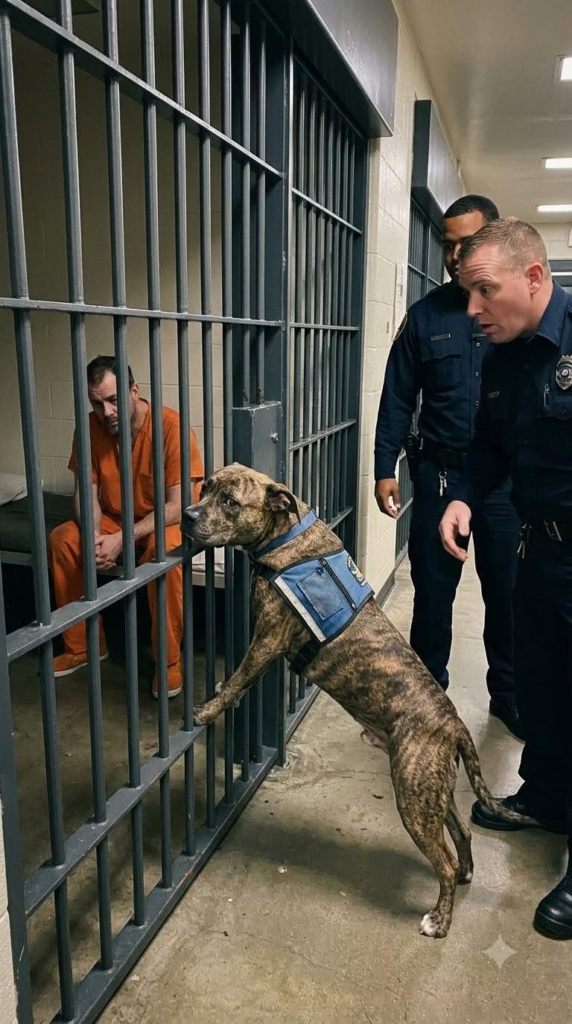
Bruno was a seven-year-old brindle Pitbull who worked at Blackstone Ridge as a certified therapy dog. He was not a police animal. He was not trained to chase suspects or protect officers. His entire purpose was helping people. He visited inmates during rehabilitation sessions, sat beside veterans struggling with trauma, and provided comfort to prisoners who had difficulty controlling anxiety.
Everyone knew Bruno.
He was gentle.
Patient.
Almost impossibly calm.
There were inmates who refused to speak to counselors but would open up when Bruno sat beside them. There were men who never showed emotion in front of another person but would quietly scratch Bruno behind the ears for several minutes.
Nobody had ever seen him act aggressively.
Until that moment.
The second Marcus stepped toward the doorway, Bruno rushed forward and placed himself between the inmate and the officers.
The entire corridor stopped.
One officer froze with his hand still holding the keys. Another looked down in confusion. The fluorescent lights above continued buzzing, but suddenly that sound seemed louder than everything else.
“What is wrong with him?” one officer asked.
Nobody answered.
Because Bruno was not attacking.
He was not growling.
He was not showing his teeth.
Instead, the Pitbull pressed his body against the steel doorway and lowered himself to the ground. His chin touched the cold concrete. His eyes stayed fixed on the officers.
Then everyone heard it.
A quiet whimper.
It was not the sound of aggression.
It was the sound of fear.
Of sadness.
Of an animal desperately trying to communicate something no human understood.
Marcus looked down at Bruno, and something changed in his face.
For the first time that day, the emotion he had been hiding appeared.
“Bruno…”
His voice was low and tired.
“It’s okay, boy. Move.”
But Bruno did not move.
The dog looked at him and let out another soft whine.
When the prison warden, Victoria Lawson, arrived moments later, she expected to find a security problem. She had spent twenty years working in corrections and had built her career on control, discipline, and following procedure.
She looked down the hallway and saw a prisoner standing behind a therapy dog who refused to let anyone pass.
“Remove the animal.”
An officer approached carefully.
But Bruno did something nobody expected.
He did not fight.
He did not resist.
He simply pressed himself harder against the doorway.
Like a shield.
Victoria stared at him.
The dog was not protecting himself.
He was not protecting the cell.
He was protecting Marcus Hale.
The inmate everyone had already decided was beyond saving.
Then a young officer named Ryan Cooper suddenly looked toward the security monitors mounted on the wall.
His expression changed.
“Wait.”
Everyone turned.
Ryan stepped closer to the screen.
“I think Bruno knew something before any of us did.”

PART 2
The Therapy Pitbull Prison Rescue investigation began when the officers reviewed the security footage from the moments before the confrontation. What they saw changed the entire situation.
The cameras showed Marcus sitting alone in his cell before Bruno arrived. At first, nothing seemed unusual. The former Marine was simply sitting quietly, staring at the floor.
Then Bruno entered.
The dog immediately walked toward him.
He ignored everything else around him.
He sat directly beside Marcus.
The inmate reached down and placed his hand on Bruno’s head.
For several minutes, neither of them moved.
Ryan paused the video.
“Look at Marcus.”
Everyone watched carefully.
The expression on Marcus’s face was not anger.
It was exhaustion.
Not the kind caused by lack of sleep.
The kind caused by carrying something painful for too long.
The warden turned toward him.
“What are you hiding?”
Marcus remained silent.
Then finally, he looked at Bruno.
“He knows when something is wrong.”
Nobody understood.
Marcus explained that after leaving the Marines, he struggled with injuries that affected both his body and his mind. The transition back into civilian life was harder than he expected. Over time, he lost relationships, lost trust, and eventually became someone who stopped asking for help.
But Bruno had always noticed.
The dog recognized when Marcus was having a difficult day.
He noticed changes in his breathing.
He noticed when Marcus became unusually quiet.
He noticed when something was wrong.
“He doesn’t care what people think I am,” Marcus said quietly. “He only knows when I need someone.”
Those words changed the way everyone looked at the situation.
The prison medical team reviewed Marcus’s condition and discovered that he had been experiencing severe stress symptoms that required attention. The move to solitary confinement could have placed him in a situation where nobody would have noticed how badly he was struggling.
The dog had not delayed the transfer.
He had prevented a crisis.
For the first time, the officers realized Bruno was not interfering.
He was warning them.
The same dog everyone thought was causing a problem had actually been the only one trying to solve it.
PART 3
After that day, the story of the Therapy Pitbull Prison Rescue spread throughout Blackstone Ridge Correctional Facility. People who had spent years judging Marcus Hale began looking at him differently.
He was still responsible for his actions.
He still had consequences to face.
But he was no longer invisible.
Marcus was transferred into a rehabilitation program instead of solitary confinement. He began attending counseling sessions regularly. He started talking more with staff members and other inmates.
And Bruno remained beside him.
Months later, I saw Marcus walking through the rehabilitation wing with Bruno at his side. The difference was impossible to miss. The same man who once walked through the prison halls with his head lowered was now smiling.
I stopped beside him.
“Looks like Bruno is still watching over you.”
Marcus looked down at the Pitbull and smiled.
“No.”
He scratched Bruno behind the ears.
“He’s reminding me that someone still sees me.”
I never forgot that sentence.
Because that was what Bruno had done.
He had seen something everyone else ignored.
He did not see a prison file.
He did not see a criminal record.
He did not see the mistakes written on a piece of paper.
He saw a person.
A person who was hurting.
A person who had spent years believing nobody cared anymore.
And when everyone else was ready to close a steel door and walk away, a seven-year-old Pitbull stood in the doorway and refused to let that happen.
Bruno never needed words.
He never needed authority.
He never needed anyone’s permission.
He simply knew someone needed him.
And sometimes, the greatest acts of courage are not loud.
Sometimes they are quiet.
Sometimes they look like a dog lying on a cold concrete floor, refusing to move until someone finally listens.
