
A Senior Beagle Was Found Curled Up Beside a Quiet Country Road, So Thin, Injured, and Exhausted That He Could Barely Lift His Head or Stand Without Collapsing Into the Wet Grass, and After Veterinarians Revealed Multiple Fractures and a Devastating Injury to His Hind Leg and Pelvis, Some People Began Asking Whether an Old Stray Dog With No Known Owner Was Really Worth the Cost of Saving—Until One Person Refused to Walk Away…

PART 1 — THE DOG IN THE DITCH
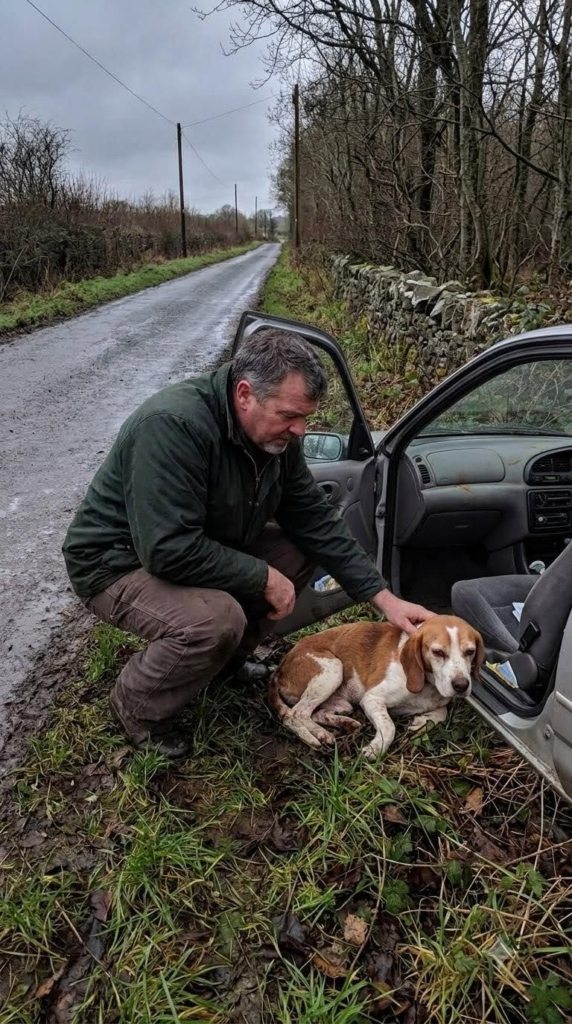
Senior Beagle rescue was the last thing Ethan Miller expected to become part of his life on a cold Tuesday morning in rural North Carolina. The forty-five-year-old construction supervisor had driven the same narrow county road outside Boone countless times, usually before sunrise, when the fields were still covered in mist and the only sounds came from birds hidden in the trees and the occasional truck passing in the opposite direction. That morning, however, something lying beside a drainage ditch caught his attention. At first, Ethan thought it was an old piece of clothing or perhaps a torn garbage bag that had been pushed into the grass by the wind. He continued driving, but the image stayed in his mind. After nearly a minute, he slowed down, looked into his rearview mirror, and suddenly realized that the shape seemed to have moved.
He immediately turned the truck around.
When Ethan parked on the shoulder and walked back, he discovered an elderly Beagle curled tightly against the muddy edge of the ditch. The dog was so still that Ethan initially wondered whether he was alive. Then one dark eye opened. The Beagle lifted his head perhaps an inch, looked directly at Ethan, and then allowed it to fall back into the wet grass. His body was painfully thin, with ribs visible beneath his dirty coat. Mud covered his legs and belly, small cuts marked his face and shoulders, and several areas of fur had become tangled with leaves and burrs. One of his back legs was swollen and held at an unnatural angle. Even more disturbing was the way the dog seemed completely exhausted. He didn’t bark. He didn’t growl. He didn’t try to crawl away. He simply lay there, breathing slowly, as if he had already spent the last of his strength simply staying alive.
Ethan crouched several feet away.
“Hey, old boy. I’m here to help you.”
=
The Beagle’s ears moved slightly.
Ethan reached for his phone and called animal control. While waiting, he removed his heavy work jacket and carefully placed it around the dog. The Beagle barely reacted. Ethan had rescued stray animals before, but this felt different. Usually even frightened dogs showed some instinct to protect themselves. This one didn’t have enough energy left for fear.
When animal-control officer Denise Parker arrived, she immediately called for emergency veterinary assistance. She and Ethan carefully slid a thick blanket beneath the Beagle. The moment they tried to lift his hindquarters, the dog cried out sharply, and Ethan instinctively tightened his grip around the blanket.
“Easy, buddy. Easy.”
The dog trembled.
“I know it hurts.”
They transported him to a nearby emergency veterinary hospital, where Dr. Natalie Brooks and her team were already preparing an examination room. The Beagle was immediately placed on fluids and given medication to control his pain. Technicians cleaned the worst of the wounds while doctors checked his breathing, temperature, hydration, and circulation. His condition was worse than Ethan had imagined. He was severely underweight, dehydrated, and extremely weak. His muscles had wasted away, suggesting that he hadn’t been receiving adequate food or proper care for quite some time. But the biggest concern was the damage to his hindquarters.
The first X-rays were taken shortly after noon.
Then the veterinarian asked for additional images.
Ethan waited outside the treatment room, still wearing his muddy work boots.
When Dr. Brooks finally came out, her expression was serious.
“He has several fractures.”
Ethan stood immediately.
“How bad?”
“The pelvis is fractured, and there is significant damage involving one of his hind legs. We’re also concerned about soft-tissue injuries and how long some of these injuries may have been untreated.”
Ethan looked through the glass at the tiny Beagle lying beneath a blanket.
“Can you save him?”
Dr. Brooks paused.
“We may be able to.”
Ethan noticed the hesitation.
“What does that mean?”
“It means he needs surgery, but surgery isn’t the only challenge. He’s old, he’s extremely underweight, and his body is already exhausted. Even if the procedure goes well, recovery could take weeks or months. There’s no guarantee he’ll ever walk normally again.”
Ethan looked at the dog again.
“What’s his name?”
The veterinarian shook her head.
“We don’t know. No collar. No identification. No owner has come forward.”
Ethan was silent for a moment.
Then he said, “He needs a name.”
Dr. Brooks smiled faintly.
“Do you have one?”
Ethan looked at the Beagle’s white muzzle and tired brown eyes.
“Arthur.”
And that was how the old stray became Arthur.
The name seemed to change something, at least for Ethan. He stopped thinking of him as the injured Beagle from the ditch and started thinking of him as a dog who had a future, however uncertain that future might be. He went back to the hospital later that evening, even though nobody had asked him to return. Arthur was sleeping when Ethan entered the room. He looked smaller beneath the blankets than he had beside the road.
Ethan sat down.
“I don’t know what happened to you.”
Arthur didn’t move.
“I don’t know where you came from, and I don’t know who left you out there.”
The Beagle’s eyes opened.
“But you’re not alone anymore.”
Arthur slowly lifted his head.
Ethan placed his hand near the blanket.
After several seconds, Arthur moved his nose forward until it touched Ethan’s fingers.
That tiny gesture stayed with him.
The following morning, the veterinary team discussed the cost of surgery and rehabilitation. It was not going to be inexpensive. The procedure would require specialized orthopedic work, followed by strict rest and physical therapy. Because Arthur was older and had been neglected for an unknown period of time, there were significant risks.
Someone asked whether a rescue organization might be able to take responsibility for him.
Another person wondered whether there were limits to how much should be spent on a senior dog with no known owner.
The conversation wasn’t cruel.
It was practical.
Animal shelters and veterinary hospitals faced difficult choices every day.
But Ethan couldn’t stop thinking about Arthur lying in that ditch.
He finally asked the veterinarian how much the surgery would cost.
Dr. Brooks gave him the estimate.
Ethan stared at the number for several seconds.
Then he nodded.
“I’ll cover what I can.”
The veterinarian looked at him.
“You understand there are no guarantees?”
“I understand.”
“He may always have a limp.”
“Then he’ll limp.”
“He may need months of rehabilitation.”
“Then we’ll take months.”
“And there’s still a possibility that he won’t make it.”
Ethan looked through the glass again.
“Then at least he’ll know somebody tried.”

PART 2 — THE FIGHT TO STAND AGAIN
Arthur underwent surgery two days later. The procedure lasted several hours, and Ethan spent most of that time sitting alone in the waiting room with his hands clasped between his knees. He had turned off his phone because he couldn’t stand hearing it ring. Every time a veterinary technician walked through the doors, he looked up. Every time someone stopped near the reception desk, he wondered whether they were coming to tell him something about Arthur.
Eventually, Dr. Brooks appeared.
“He’s out.”
Ethan stood.
“How is he?”
“He made it through the surgery.”
Ethan closed his eyes for a moment.
“Thank God.”
“He’s not out of danger yet. The next several days are important.”
“Can I see him?”
A few minutes later, Ethan stood beside Arthur’s recovery area. The Beagle was heavily sedated, wrapped in blankets, with monitoring equipment attached around him. His eyes opened slightly when Ethan approached.
“Hey, Arthur.”
One ear moved.
“You remember me?”
Arthur’s eyes closed again.
Ethan smiled.
“That’s okay. Get some sleep.”
The first week after surgery was harder than anyone hoped. Arthur survived the operation, but his body was weak. He barely wanted to eat, and the veterinary staff had to encourage him to take small amounts of food. His pain medication kept him comfortable, but he spent long periods sleeping. When he did wake, he often stared at the wall with an expression that made Ethan wonder whether he understood how much his life had changed.
Every afternoon, Ethan returned.
Sometimes he talked.
Sometimes he read messages on his phone while sitting beside Arthur.
Sometimes he simply placed a hand against the blanket and remained silent.
One evening, after several days of almost no visible progress, Ethan leaned closer.
“You don’t have to be brave every second.”
Arthur opened his eyes.
“Just stay.”
The Beagle stared at him.
Then something happened.
Arthur’s tail moved.
Once.
It was so small that Ethan almost missed it.
He stopped breathing.
“Did you just wag your tail?”
A veterinary technician looked over.
Arthur’s tail moved again.
Ethan laughed, and then his eyes filled with tears.
“That counts.”
The technician smiled.
“It absolutely counts.”
It was the first unmistakable sign that Arthur was beginning to recover.
His appetite improved slowly after that. He began eating small meals without encouragement. He started lifting his head whenever Ethan entered the room. He became more interested in sounds around him. When someone walked down the hallway, his ears followed them.
And then came the first attempt to stand.
The rehabilitation specialist, Sarah Bennett, placed Arthur carefully on a padded surface. His body trembled immediately. His front legs shook under his weight, and his injured rear leg barely responded.
“Easy,” Sarah said.
Arthur tried.
His body rose several inches.
Then he collapsed.
Ethan instinctively stepped forward.
Sarah stopped him.
“Let him try again.”
Arthur remained on the floor for several seconds.
Then he pushed himself up again.
This time he stayed upright for two seconds.
Then three.
Then four.
His legs trembled violently.
But he was standing.
Ethan covered his mouth.
Arthur looked around as if confused by what he had just accomplished.
“You’re standing,” Ethan whispered.
Arthur’s tail moved.
The rehabilitation process became the center of his days. At first, Arthur could only stand for a few seconds. Then he learned to shift his weight. Then he managed one step with assistance. His progress was painfully slow, but every small achievement mattered.
There were setbacks too.
Some mornings Arthur was exhausted and refused to move.
Other days, his injured leg seemed too painful.
Once, after attempting several steps, he simply sat down and looked at Sarah with an expression that seemed to say he was finished.
Sarah laughed.
“Okay, Arthur. We’ll try again tomorrow.”
Ethan knelt beside him.
“You heard her.”
Arthur rested his head against Ethan’s knee.
“You don’t have to win every day.”
Weeks passed.
Arthur became stronger.
His face began to fill out.
The sharp outline of his ribs slowly disappeared.
His coat became cleaner and softer.
Most importantly, his eyes changed.
The dull exhaustion that had been there when Ethan found him was gradually replaced by curiosity.
Arthur started watching people.
He learned the sound of the refrigerator.
He discovered treats.
He became fascinated by the squeak of a tennis ball.
The veterinary staff joked that he was developing opinions.
“He’s not the same dog,” Sarah said one afternoon.
Ethan smiled.
“He finally has enough energy to complain.”
Arthur had indeed become more expressive. If someone stopped petting him too soon, he would stare at them. If Ethan left the room, Arthur watched the doorway. If another dog barked outside, Arthur’s ears perked up.
One afternoon, after several weeks of rehabilitation, Sarah placed a treat a few feet away.
Arthur stood.
He took one step.
Then another.
His back leg wobbled.
He stopped.
Ethan held his breath.
Arthur took another step.
Then another.
He reached the treat.
The entire rehabilitation room erupted in quiet applause.
Arthur looked around, completely unimpressed by the attention.
Then he ate the treat.
Ethan laughed.
“You’re acting like you do that every day.”
Arthur’s tail wagged.
But the truth was that this was extraordinary.
A few weeks earlier, he couldn’t stand beside the road.
Now he had walked across an entire room.
His recovery was far from finished, but something fundamental had changed.
Arthur had stopped surviving.
He had started living.
PART 3 — THE LIFE HE ALMOST NEVER GOT
Arthur finally went home nearly six weeks after Ethan had found him beside the drainage ditch. His discharge instructions were long. He needed controlled exercise, regular rehabilitation, careful monitoring, and plenty of rest. He couldn’t climb stairs freely, jump from furniture, or chase anything too aggressively. His injured leg would probably never function exactly as it had before.
But he was going home.
Ethan had prepared a quiet corner in his house with a thick orthopedic bed, blankets, water, food, and a collection of toys that Arthur had never seen before.
When the front door opened, Arthur stood in the hallway.
He looked around.
He sniffed the floor.
Then he slowly walked into the living room.
He stopped beside an old recliner.
Turned around.
Lowered himself carefully.
And fell asleep.
Ethan smiled.
“Guess that’s your chair now.”
From that day forward, Arthur became part of the household.
His life was not dramatic anymore.
And that was exactly what Ethan wanted.
Arthur spent mornings sleeping near the window. He followed Ethan from room to room, although sometimes he needed to stop and rest. He developed a habit of waiting near the kitchen whenever Ethan opened the refrigerator. He discovered that carrots were surprisingly good. He also discovered that he had absolutely no interest in sharing them.
His limp remained.
It was obvious when he walked.
His rear leg moved differently from the others, and he sometimes tilted his body to compensate.
But he was mobile.
And he was happy.
A few months after the rescue, Ethan took Arthur into the backyard for the first time without a leash.
The grass was soft beneath his paws.
Arthur stood still for several seconds.
Then he noticed something lying near the fence.
A tennis ball.
Ethan had bought it weeks earlier but hadn’t known whether Arthur would ever be able to play.
He picked it up.
“You want this?”
Arthur’s ears rose.
Ethan gently tossed it several feet.
Arthur stared.
Then he moved.
One step.
Two.
Three.
His pace quickened.
It wasn’t really running.
Not yet.
But it was a little trot.
His injured leg swung awkwardly, his body leaned slightly to one side, and his ears bounced with every uneven step.
Ethan stood in the middle of the yard laughing.
Arthur reached the ball.
He picked it up.
Then he turned around.
For a moment, Ethan simply stared at him.
The dog in front of him was the same dog he had once found lying helpless in the wet grass.
The same dog who couldn’t lift his head.
The same dog whose future had been questioned because he was old, injured, and unknown.
But now Arthur was standing in the sunshine with a tennis ball in his mouth.
Ethan wiped his eyes.
“You made it.”
Arthur trotted toward him.
He dropped the ball at Ethan’s feet.
Then he looked up expectantly.
Ethan laughed.
“You want me to throw it again?”
Arthur’s tail wagged.
So Ethan did.
That became part of their routine.
Not every day.
Not for long.
Arthur had limits.
But when his body felt good, he would limp across the backyard after that faded tennis ball with the determination of a puppy.
His permanent limp never disappeared.
Neither did the scars.
But neither one stopped him.
Over time, Ethan began thinking about that morning on the country road less often. Not because he had forgotten it, but because Arthur’s life had become so different from the image of that helpless dog in the ditch.
Sometimes, however, he would look at Arthur sleeping beside the recliner and remember.
He remembered the wet grass.
He remembered the trembling body.
He remembered how Arthur had been too exhausted to resist being lifted.
He remembered the veterinarian saying there were no guarantees.
And he remembered his own answer.
Then we’ll try.
Months later, Ethan was asked why he had spent so much money on a senior dog whose past nobody knew and whose future had been so uncertain.
He never had a complicated answer.
“He was still here.”
That was all.
Arthur didn’t know how much his surgery had cost.
He didn’t know people had questioned whether saving him made sense.
He didn’t know that his age had been part of the conversation.
He didn’t know that nobody knew where he came from.
He didn’t know how close he had come to dying alone beside that road.
He only knew that one morning, someone stopped.
Someone saw him.
Someone picked him up.
Someone took him somewhere warm.
And when he couldn’t stand, someone stayed.
That was enough.
Arthur never needed to prove that he was worth saving.
His value had never depended on his age, his health, his ability to walk without a limp, or whether he had an owner waiting somewhere to claim him.
He was worth saving because he was alive.
And now, whenever Ethan sits in the old recliner and feels Arthur’s head slowly settle against his leg, he sometimes looks down at the aging Beagle and remembers the question that once surrounded him.
Was an old, badly injured stray really worth the cost?
Arthur cannot answer with words.
Instead, he gets up.
He walks slowly across the room.
He carries his favorite tennis ball outside.
He limps across the grass beneath the afternoon sun.
And for a few precious seconds, he forgets that his leg was ever broken.
He simply trots.
Not perfectly.
Not quickly.
But freely.
The road had almost taken everything from him.
The injuries had taken months of his life.
His body would carry those scars forever.
But the rest of his life belonged to him.
And that was the second chance nobody could take away.
Arthur had once been a dog lying alone beside a country road, too weak to stand while cars passed him by.
Now he was the dog who waited beside Ethan’s chair every evening, the dog who followed him from room to room, the dog who chased a battered tennis ball across the backyard with an uneven little gait that somehow made every step more beautiful.
His recovery was never perfect.
It didn’t need to be.
Because sometimes surviving doesn’t mean returning to the way things were before.
Sometimes survival means discovering that even after everything has gone wrong, there can still be a warm bed, a safe home, a favorite chair, a hand resting gently on your head, and someone who believes you deserve another morning.
Arthur got that morning.
Then another.
And another.
And eventually, he got an entire life he almost never had.
The old Beagle who was once considered too injured, too expensive, and too uncertain to save never became a perfect dog.
He became something better.
He became a dog who knew he was finally home.

