After Losing All Six of Her Newborn Puppies in a Horrific Storm-Related Highway Accident, This Young Mother Dog Shut Down Completely Inside a Crowded Shelter—She Wouldn’t Eat, Drink, or Even Lift Her Head for Five Days, Until a 26-Year-Old Vet Tech Brought Her Something Inside a Cardboard Box…

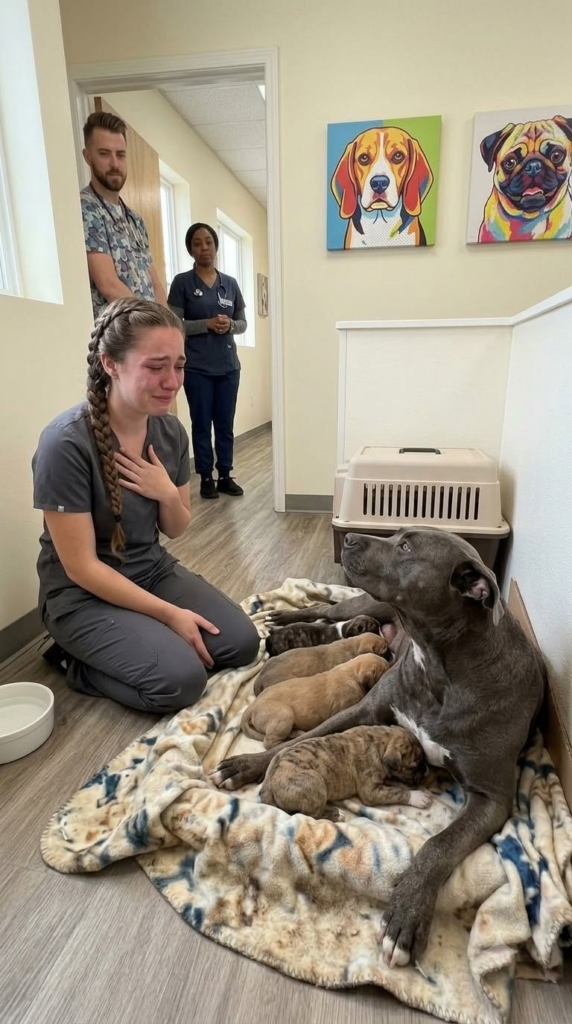
PART 1
The rain had been falling over northern Georgia for nearly six hours when the accident happened, turning the highway outside Gainesville into a dangerous ribbon of black asphalt reflecting headlights through sheets of water. Visibility had dropped so badly that drivers were creeping along with their hazard lights flashing, but the small transport van carrying a young Boxer mother and her six newborn puppies was already running behind schedule. Inside the vehicle, the mother dog had been lying inside a secured compartment with her puppies tucked close against her body, their tiny cries occasionally disappearing beneath the roar of the storm. They were only days old, blind and helpless, completely dependent on their mother for warmth and milk, and nobody inside that vehicle could have known that before the night was over, nearly everything that little family had would be taken away.
The driver later told authorities that the van hydroplaned on a curve. The rear end swung violently, the tires lost contact with the road, and the vehicle spun across the wet pavement before crashing through a metal guardrail. The sound of twisting steel and breaking glass was followed by a terrifying slide down a muddy embankment. When emergency responders finally reached the wreck, the storm was still raging, and muddy water was pouring through the damaged vehicle. The driver survived with injuries, but the six puppies did not. Their tiny bodies were recovered from the wreckage, and by the time animal-control officers arrived, there was nothing anyone could do for them. The mother, however, was found alive beneath a damaged section of the vehicle, trembling violently but still conscious. Her name was Daisy, a young Boxer who had apparently been trying to reach the place where her puppies had been trapped even after the crash had ended.
Physically, Daisy seemed remarkably fortunate. She had bruising around her ribs, several cuts along her flank, and a swollen paw, but the veterinarian who examined her at the emergency clinic found no life-threatening injuries. What worried the rescuers was not what they could see on her body, but what happened when they tried to separate her from the wreckage. Daisy kept turning toward the same spot, pushing her nose beneath twisted metal and making almost no sound. She wasn’t aggressive, and she wasn’t panicking. She simply kept searching. When rescuers finally carried her away, she looked over her shoulder again and again until the wreck disappeared from view.
She was transferred to Ridgewood Animal Rescue the following morning, where a crowded collection of dogs, cats, injured wildlife, and abandoned animals made the shelter unusually noisy. Volunteers expected Daisy to be frightened, but what they witnessed was something far more disturbing. She walked calmly into kennel twelve, turned toward the wall, lowered her head, and stopped responding to the world around her. A volunteer offered her water. She didn’t drink. Another brought her warm food. She didn’t smell it. When someone called her name, her ears didn’t move. Even when the shelter doors slammed and several dogs began barking only a few feet away, Daisy remained completely still, her eyes fixed on the corner as though she were trying to disappear into it.
For the first day, the staff assumed she was exhausted from the accident. On the second day, they became concerned. By the third, they started keeping detailed notes of everything she consumed because almost nothing was going into her body. By the fourth day, Daisy had barely touched her water and had eaten practically nothing. Her physical injuries were beginning to heal, but her condition was getting worse. The shelter veterinarian, Dr. Marcus Ellison, warned the staff that dehydration and prolonged refusal to eat could become dangerous, especially for an animal already weakened by trauma. They tried different foods, different bowls, quiet rooms, blankets, gentle voices, and even leaving her completely alone. Nothing changed.
=
By the fifth morning, Daisy had become the dog everyone at Ridgewood was talking about in whispers. She had not barked once since arriving. She had not wagged her tail. She had not attempted to leave her kennel. She simply remained pressed against the wall, her breathing slow and shallow. Shelter manager Nora Bennett stood outside kennel twelve one morning with tears in her eyes and watched Daisy for nearly a minute before quietly saying what everyone else was afraid to admit.
“I don’t think she’s waiting for us anymore.”
No one answered her.
That same morning, twenty-six-year-old veterinary technician Claire Whitmore arrived for her shift. Claire had worked with traumatized animals for years, and although she knew she couldn’t magically erase grief, she had learned that sometimes an animal didn’t need to be persuaded to trust again. Sometimes it needed to be given something familiar enough to remind it that the world had once contained warmth.
Claire read Daisy’s medical file, then stood outside kennel twelve. She didn’t immediately enter. Instead, she watched. Daisy was facing the wall, exactly as she had been for days. Claire crouched near the bars.
“Hey, girl. I’m Claire.”
Daisy didn’t react.
Claire remained there for another few seconds.
“You don’t have to come to me.”
Still nothing.
Claire eventually stood and walked toward the storage room. Nora watched her disappear around the corner.
“Where are you going?”
Claire glanced back.
“I need something.”
“What?”
Claire shook her head.
“I’m not sure yet.”
Twenty minutes later, she returned carrying a small cardboard box. It looked completely ordinary, the kind of box that could have contained medical supplies or donated blankets. Nora frowned when she saw it.
“What exactly are you planning to do with that?”
Claire lowered her voice.
“Nothing dramatic. I just want to see if she remembers something.”
Claire entered Daisy’s kennel alone and placed the box several feet away. She then sat on the floor with her back against the opposite wall. She didn’t open the box immediately. She didn’t call Daisy. She didn’t reach for her. She simply waited.
For almost a minute, nothing happened.
Then Daisy’s nose moved.
Claire noticed.
Daisy sniffed again.
Her head lifted perhaps half an inch.
Nora, watching from outside, stopped breathing.
Daisy slowly turned her face away from the wall.
Her eyes settled on the cardboard box.
Claire gently opened it.
Inside was a folded piece of fabric recovered from the transport vehicle after the accident. It had been cleaned, dried, and carefully sealed, but Claire had been told by the rescue team that traces of the puppies’ scent might still remain.
Daisy stared at it.
Then she stood.
Her legs trembled beneath her as she took one slow step forward.
Then another.
She reached the box and lowered her nose.
The change was immediate.
Her breathing became faster. Her ears lifted. She sniffed the fabric repeatedly, and then her entire body began to tremble.
Claire whispered,
“It’s okay, Daisy.”
Daisy pressed her face into the fabric and released a soft, broken cry.
Nora covered her mouth.
It was the first sound Daisy had made in five days.
But Claire wasn’t prepared for what happened next.
Because Daisy suddenly pulled back from the box, stared toward the shelter entrance, and began pacing in circles as if she had remembered something that nobody else in the room understood.
Then she stopped directly in front of Claire.
And stared at her.

PART 2
Claire had seen grief in animals before, but she had never seen anything quite like the expression on Daisy’s face that morning. It was not simply sadness. There was recognition, confusion, and something resembling desperate expectation all mixed together. Daisy kept looking toward the cardboard box, then toward the shelter entrance, then back at Claire as if she were trying to communicate something that words could not express. Claire placed a bowl of water beside her and waited. Daisy stared at it for several seconds before finally lowering her head and drinking. She drank slowly at first, then more urgently, until the bowl was nearly empty. Nora stood outside the kennel with tears running down her cheeks because five days earlier, the dog had refused even a drop.
“She’s coming back,” Nora whispered.
Claire nodded.
“Maybe.”
But Claire knew better than to celebrate too soon. Daisy had survived a terrible trauma, and one moment of progress did not mean she was safe. She needed food, hydration, medical monitoring, and time. Claire offered her a small portion of warmed chicken and rice. Daisy sniffed it, turned away, then returned a few minutes later and ate three bites. It wasn’t much, but it was enough to convince Dr. Ellison that they had finally found a way to reach her.
That afternoon, Claire reviewed the accident records again. Something about Daisy’s behavior bothered her. The mother dog wasn’t simply mourning. She kept looking toward the shelter entrance as though she expected someone to arrive. Claire reread the transport report, including the list of animals in the vehicle. Six puppies. One mother. Everything appeared correct. Then she found an attached handwritten note from the first responder who had reached the crash site. The note mentioned that several pieces of equipment had been thrown from the vehicle during the impact, including a small plastic carrier that had landed farther down the embankment.
Claire’s heart skipped.
She called the county animal-control office.
“Do you still have the items recovered from the crash?”
The officer on the phone said yes.
“Was there a carrier?”
There was a pause.
“Yes. Why?”
“Was it inspected?”
“I believe so.”
Claire frowned.
“Do you remember what was inside?”
The officer hesitated.
“I remember it being empty.”
Claire looked toward Daisy.
“Are you certain?”
The officer said he would check.
Twenty minutes later, Claire received photographs from the crash scene. She enlarged the images on her computer. In one photograph, the small carrier was visible several yards from the main wreckage, partially buried in mud and surrounded by broken branches. It was upside down.
Claire zoomed in.
Beneath it was something that looked like a blanket.
She called Nora.
“Come here.”
Nora leaned over the computer.
“What am I looking at?”
“I don’t know.”
Claire zoomed in again.
There was a dark shape beneath the carrier.
Nora’s face changed.
“Is that…”
“I don’t know.”
“Claire.”
“I said I don’t know.”
But both women knew what they were thinking.
If the carrier had been thrown from the vehicle before the crash settled, there was a possibility that something inside it had survived. It was a tiny possibility. An almost impossible possibility. The accident had happened five days earlier, and the area had been battered by rain ever since. Any living creature trapped there would have been exposed to cold, mud, dehydration, and hunger.
Still, Claire couldn’t ignore the photograph.
She contacted animal control and asked them to return to the site.
The search team arrived late that afternoon. They followed the original route down the embankment, searching through thick brush and mud. Water had washed debris into the nearby ditch, making the area difficult to navigate. For nearly two hours, they found nothing. One officer suggested they stop because daylight was fading, but another continued searching near the lower part of the embankment.
Then he saw something.
A piece of plastic.
He moved several branches aside.
The carrier was there.
It was covered in mud and partially wedged beneath a fallen tree.
The officer crouched.
“Hey.”
His partner walked over.
“What?”
“Listen.”
They both became still.
There was a sound.
Very faint.
Almost impossible to hear over the rain.
A tiny squeak.
The officer carefully pulled the carrier free and turned it over.
Inside was a wet blanket.
He lifted it.
Then he froze.
Underneath was a tiny puppy.
Alive.
Barely.
The animal was cold, weak, and dehydrated, but its chest was moving.
The rescue team immediately wrapped the puppy in dry towels and called the shelter.
When Claire answered the phone, she listened for several seconds without saying a word.
Then she whispered,
“You’re sure?”
The voice on the other end answered.
Claire closed her eyes.
“Bring him here.”
She hung up.
Nora looked at her.
“What?”
Claire’s eyes filled with tears.
“One puppy survived.”
The words seemed to stop the entire room.
Daisy, who had been lying beside the cardboard box, suddenly lifted her head.
She stood.
Her nose pointed toward the shelter doors.
She began pacing.
She sniffed the air.
Then she made that same soft crying sound.
Claire crouched beside her.
“Daisy…”
The mother dog looked directly into her eyes.
Claire swallowed hard.
“We found him.”
Daisy’s body trembled.
The puppy arrived shortly after sunset. He was so small that Claire could hold him in one hand, but his condition was extremely fragile. Dr. Ellison immediately placed him inside a warming incubator, administered fluids, and began monitoring his temperature and breathing. The puppy made a tiny sound.
Daisy heard it.
She stopped moving.
Her ears lifted.
For the first time since the accident, her eyes looked alive.
Claire looked at Nora.
“She knows.”
Nora nodded.
“But we have to be careful.”
“I know.”
The puppy survived the night.
So did Daisy.
And the next morning, Claire made a decision that would change both of their lives.
She took the puppy out of the incubator, wrapped him in a clean blanket, and carried him toward kennel twelve.
Daisy watched every step.
Claire opened the door.
Daisy approached slowly.
She sniffed the blanket.
Then she touched her nose to the puppy.
The tiny animal squeaked.
Daisy immediately lowered herself to the floor and curled her body around him.
She licked his head once.
Then again.
The puppy moved closer.
Daisy closed her eyes.
The shelter staff stood silently outside the kennel.
Nobody spoke.
Because everyone understood what they were witnessing.
The mother who had lost six babies had finally found one.
PART 3
The surviving puppy was given the name Oliver, and over the next several days, the shelter staff watched a transformation they had never expected to see. Oliver was fragile, but he was stubborn, and Daisy became fiercely protective of him. She refused to leave his side for more than a few minutes. Whenever he cried, she responded immediately. Whenever he slept, she rested her chin beside him. She had gone five days without moving, yet now she followed every movement Oliver made as though her entire body had suddenly remembered its purpose. She began eating regularly. She drank without hesitation. She even started walking around the kennel and eventually wagged her tail when Claire entered the room.
The cardboard box remained in the corner.
The small piece of fabric inside it remained too.
It was no longer necessary to bring Daisy back from her grief, but Claire kept it there because Daisy occasionally returned to it, sniffed it, and then went back to Oliver. It seemed as though the scent had become part of her way of remembering what had happened without being trapped inside it.
Weeks passed.
Daisy’s injuries healed.
Oliver grew stronger.
And then came the question nobody wanted to ask.
What would happen to them after the shelter?
Daisy and Oliver had become inseparable. The rescue organization refused to separate them, but finding a home willing to adopt a traumatized adult dog and a young puppy together would not be easy. Some potential adopters wanted only a puppy. Others were concerned about Daisy’s history. She had experienced a horrific accident, lost six puppies, and still became nervous whenever she heard heavy rain.
Then a couple named Matthew and Elise Harper contacted Ridgewood Animal Rescue.
They lived outside Athens, Georgia, and had followed Daisy’s story online.
“We don’t want to separate them,” Elise told Claire.
Claire looked at Daisy.
“You understand that Daisy may need a lot of patience?”
Elise smiled.
“We have plenty.”
When the couple came to meet them, they didn’t rush into the kennel. Elise sat on the floor several feet away from Daisy and waited.
Daisy watched her.
Matthew sat beside his wife.
Nobody called the dog.
Nobody reached for her.
After several minutes, Daisy slowly walked forward.
She sniffed Elise’s hand.
Then she sat down.
Elise’s eyes filled with tears.
“Hi, sweetheart.”
Daisy leaned against her knee.
Claire knew immediately.
This was the family.
The adoption was finalized two weeks later.
On the morning Daisy and Oliver left the shelter, Claire placed the old cardboard box inside their new travel crate.
Nora raised an eyebrow.
“You’re really sending that box with them?”
Claire smiled.
“Absolutely.”
Daisy watched as Oliver was placed safely beside her.
Then she looked at Claire.
Claire crouched down.
“You don’t need this place anymore.”
Daisy stared at her.
Claire gently touched her forehead to Daisy’s.
“You have a home now.”
Daisy licked her hand.
Then she climbed into the vehicle.
Oliver curled against her side.
As the car pulled away, Claire stood in the parking lot until it disappeared beyond the trees.
Months later, Claire received a photograph from Elise.
Daisy was lying in the middle of a bright living room, completely relaxed. Oliver was sleeping against her belly, his paws stretched toward her front legs. Behind them was a large window, and beyond it, rain was falling over the Georgia countryside.
Claire stared at the picture.
Then she noticed something in the corner.
The cardboard box.
It had been turned into a little toy container.
Oliver’s favorite stuffed animal was sticking out of the top.
Claire laughed through her tears.
The box that had once carried the scent of everything Daisy had lost now carried toys for the one little life she had managed to save.
But the story didn’t end there.
Elise later told Claire that Daisy still reacted to storms. Whenever thunder rolled across the sky, she would sometimes become restless and search the room until she found Oliver. Once she located him, she would lie beside him and remain there until the storm passed. Oliver, meanwhile, had developed a habit of climbing onto her back whenever he became frightened.
One evening, during another violent summer storm, Elise found the two dogs asleep beside the window.
Lightning flashed outside.
Thunder shook the glass.
Daisy opened her eyes.
For a moment, she looked toward the rain.
Then she looked down at Oliver.
The little puppy was still sleeping.
Daisy lowered her head and gently touched her nose to his back.
Her eyes closed again.
The storm continued outside.
But this time, Daisy didn’t run.
She didn’t hide.
She didn’t stare at a wall.
She simply stayed where she was, beside the one puppy who had survived the night that had taken everything else from her.
The young mother dog had never forgotten her six lost puppies, and perhaps she never would. There were wounds that no medicine could completely heal and memories that would always return whenever rain struck the windows too loudly. But grief had stopped being the only thing left inside her. Slowly, painfully, and with the help of people who refused to give up on her, something else had grown alongside it.
Trust.
Love.
And hope.
The cardboard box had been nothing more than an ordinary piece of cardboard when Claire first carried it into kennel twelve. She had not known whether Daisy would even notice it. She had certainly never imagined that it would become the first thing to break through five days of silence, lead rescuers to a forgotten clue from the crash, and ultimately help reconnect a mother with the only surviving piece of her shattered family.
Sometimes the smallest things can open a door that grief has locked shut.
Sometimes an animal doesn’t need someone to force her back into the world.
She only needs someone patient enough to sit beside her until she is ready.
And sometimes, after everything has been taken away, one tiny heartbeat is enough to remind a broken mother that there is still something worth protecting.
Daisy had lost six puppies that terrible night.
But she had not lost everything.
Because one survived.
And because one survived, she found the strength to survive too.