After Eight Families Rejected the Massive Elderly Saint Bernard Because He Was Too Old, Too Heavy, Too Arthritic, and Still Carried Two Torn Slippers That Smelled Like Rain and Mildew, the Shelter Staff Finally Decided the Dirty Objects Were Ruining His Chances and Tried to Throw Them Away—But Instead of Letting Them Go, the Dog Carried Them to the Exit, Placed Them Side by Side, and Waited Until an Elderly Man and His Daughter Walked Through the Door and Everything Changed…

PART 1 — THE OLD DOG NOBODY WANTED
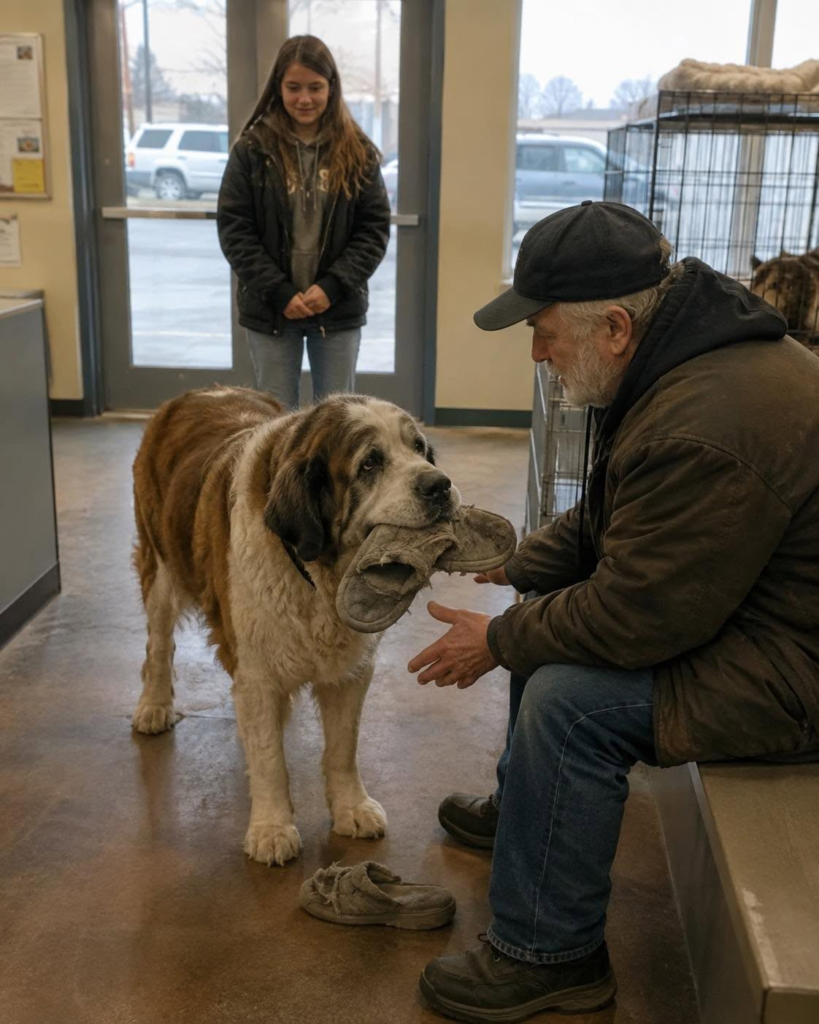
Elderly Saint Bernard was not supposed to become the most talked-about dog at the shelter that winter. In fact, by the time the ninth family arrived at the county animal rescue outside Columbus, Ohio, most of the staff had quietly accepted that finding him a permanent home might be nearly impossible. His name was Harrison, though the shelter had chosen it after animal control found him wandering beside a closed gas station because nobody had discovered a previous owner. He was fifteen years old, weighed almost 130 pounds, suffered from severe arthritis in both rear legs, and had a cloudy right eye that made him look permanently tired. His once-thick coat had become thin around his shoulders, his muzzle was almost completely white, and he needed medication twice a day just to move comfortably around the kennel. But none of those things were actually the strangest part about him. Harrison was obsessed with two old blue-plaid slippers that looked as though they had spent years outside.
The slippers were filthy despite several attempts by the shelter staff to clean them. The fabric had once been bright blue, but rain, mud, road salt, and age had faded the pattern into a dull grayish brown. One heel had been repaired with several layers of silver duct tape, while both toes were split open enough to expose the padding underneath. They carried a faint smell of mildew that never completely disappeared. Yet Harrison treated them with extraordinary care. He never tore them apart, never chewed the fabric, and never used them as toys. Instead, he kept them beneath his blanket, slept with his head resting across their heels, and carefully carried them whenever somebody came to meet him.
The shelter had witnessed the ritual eight times. Every new family would enter the meeting room, and Harrison would slowly rise from his bed, struggling against his stiff hips. He would take one slipper in his mouth, carry it across the room, place it near the visitor’s feet, then return for the second. Sometimes he had to stop halfway because his legs were shaking. Sometimes he dropped one and stood there breathing heavily before bending down again. But he always finished the task. Nobody knew why.
The ninth family arrived on a cold Thursday afternoon. Daniel Brooks, his wife Megan, and their eleven-year-old daughter Lily had originally come to look at younger dogs, but Lily had seen Harrison’s photograph online and insisted that they at least meet him. Shelter coordinator Grace Holloway brought them into the small meeting room and warned them that Harrison was elderly and needed ongoing medical care.
“He’s very gentle,” Grace explained. “But he isn’t going to behave like a young dog.”
=
Daniel nodded.
“We understand.”
Harrison entered slowly.
Lily immediately smiled.
“Oh, he’s huge.”
Harrison looked at her.
Then he turned toward his kennel.
Grace knew what was coming.
He picked up one slipper.
He walked toward Lily.
His back legs trembled beneath him.
He placed the slipper beside her sneaker.
Then he turned around and went back for the second.
Lily crouched.
“You brought me your shoes.”
Harrison dropped the second slipper beside her.
She laughed softly.
Daniel did not.
He looked down at the battered fabric.
“Those stay with him?”
Grace nodded.
“They’re important to him.”
“Why?”
“We honestly don’t know.”
Megan bent slightly and smelled the slipper before immediately pulling her face away.
“That’s not going into our house.”
Lily frowned.
“Mom.”
Megan shook her head.
“I don’t mean anything against him, honey, but look at it.”
Daniel pointed toward the slipper.
“And if we adopt him, we’d have to deal with this every day?”
Grace tried to explain that Harrison didn’t destroy them and that the slippers seemed to comfort him.
Daniel sighed.
“He’s already fifteen.”
“Yes.”
“And arthritis?”
“Yes.”
“Medication?”
“Twice daily.”
Daniel looked at Megan.
They exchanged a glance.
Lily sat on the floor and rubbed Harrison’s neck.
“He’s nice.”
Daniel softened slightly.
“I know.”
Harrison slowly lowered himself beside her.
His head rested against Lily’s knee.
For a moment, nobody spoke.
Then Daniel said quietly:
“We’re looking for a dog who can grow up with her.”
Grace understood.
The family left.
Lily looked back through the glass doors.
Harrison was still lying in the meeting room.
The two slippers were beside him.
That was rejection number nine.
After they left, Grace returned Harrison to his kennel. He picked up both slippers, carried them beneath his blanket, and curled his enormous body around them.
A volunteer named Tessa Morgan watched from the doorway.
“He’s never going to get adopted carrying those things.”
Grace sighed.
“Maybe they’re the only thing he has left.”
“But nobody knows what they mean.”
“I know.”
Tessa hesitated.
Then she made a decision she thought was kind.
Later that afternoon, while Harrison slept, she entered the kennel with a black garbage bag.
She gently picked up one slipper.
Harrison’s eyes opened.
“It’s okay, old boy.”
He slowly lifted his head.
Tessa picked up the second slipper.
Harrison stood.
His rear legs nearly collapsed beneath him.
Tessa stepped backward.
“Easy.”
Harrison stared at the bag.
Then he moved.
He crossed the kennel faster than anyone expected from a fifteen-year-old dog.
He pushed his nose into the plastic.
Tessa tried to pull the bag away.
Harrison caught the slipper through the opening.
The plastic tore.
The slipper fell.
He picked it up immediately.
Then he grabbed the second.
Grace came running when she heard the noise.
“Harrison!”
But the old dog ignored her.
He walked through the kennel hallway.
Past the adoption rooms.
Past the reception desk.
Past three families who stopped talking to watch him.
He reached the shelter entrance.
The glass doors reflected his enormous body and cloudy eye.
He placed both slippers side by side on the floor.
Then he lay behind them.
Grace approached slowly.
“What are you doing, sweetheart?”
Harrison looked through the glass.
He wasn’t looking at the staff.
He was watching the parking lot.
For nearly an hour, he refused water, treats, and even his favorite heated bed.
He simply waited.
Then, at 4:36 p.m., the shelter door opened.
An elderly man in a charcoal coat stepped inside.
A woman in blue hospital scrubs walked beside him.
Harrison immediately lifted his head.
His ears moved forward.
The woman stopped.
Her eyes went straight to the slippers.
One had flipped over slightly.
The sole was visible.
She crouched.
Her fingers brushed across the dirty rubber.
She wiped away the grime.
Three faded letters appeared.
Then part of a date.
Her face suddenly changed.
She stared at Harrison.
“Where did you get these?”
Harrison picked up the slipper.
He walked toward her.
Then he placed it gently against her knee.
The woman stopped breathing.
She whispered a name.
It was a name nobody at the shelter had heard before.
And the moment she said it, the old Saint Bernard dropped the slipper and began trembling.

PART 2 — THE NAME HARRISON REMEMBERED
The woman’s name was Claire Whitmore, and the elderly man beside her was her father, Arthur. Claire remained on the floor with Harrison’s head pressed against her shoulder, tears running down her face as she repeatedly touched the faded scar above his nose.
“I know you,” she whispered. “I know this dog.”
Grace knelt nearby.
“Who is he?”
Claire looked at her.
“His name was Harvey.”
Grace glanced at the shelter paperwork.
“We called him Harrison.”
Claire smiled sadly.
“Harvey was his name.”
Arthur stepped closer.
“He belonged to my son.”
Grace noticed the woman’s hands trembling.
“Your son?”
Claire nodded.
“His name was Elliot Whitmore.”
The name seemed to change the atmosphere inside the lobby.
Claire explained that Elliot had owned Harvey since the Saint Bernard was a puppy. They had lived together for almost thirteen years. Elliot had raised him, taken him hiking, slept beside him during thunderstorms, and joked that Harvey was the only dog in the world who could occupy an entire couch without feeling guilty about it.
Then, three years earlier, Elliot disappeared.
He had been thirty-eight.
He left home one evening and never returned.
His truck was discovered near a wooded road outside the city.
There was no sign of Elliot.
There was no confirmed evidence of an accident.
No body.
No explanation.
The search continued for months.
Harvey disappeared shortly afterward.
Claire had searched for him too.
“We thought someone took him,” she said. “We put his picture everywhere.”
Grace looked at Harrison.
“You mean Harvey.”
Claire nodded.
“We never found him.”
She looked at the slippers.
“These belonged to Elliot.”
Grace felt a chill.
“How do you know?”
Claire turned one over.
Under the dirt were the initials E.W.
“They were his.”
Arthur stared at the old dog.
“He used to wear those when he was sick.”
Claire nodded.
“He had them for years.”
Grace looked toward the shelter hallway.
“But how did they get here?”
Nobody knew.
Then Harvey, still called Harrison by the staff, suddenly stood.
He walked toward his kennel.
Claire followed.
The dog pushed his nose beneath his blanket and pulled out something small.
A leather wallet.
Claire froze.
She recognized it immediately.
“That belonged to Elliot.”
She opened it with shaking fingers.
Inside was an old photograph of Elliot and Harvey sitting together beside a lake.
On the back was handwriting.
If Harvey ever comes home, tell him I never forgot him.
Claire covered her mouth.
Arthur looked away.
Grace felt tears forming.
But Harvey wasn’t finished.
He carried the wallet toward the entrance.
Then he looked at Claire.
He looked at the door.
And waited.
Claire followed him outside.
The dog walked slowly through the parking lot.
His hips were stiff, and every few steps he stopped to catch his breath.
But he knew where he was going.
He led them toward an old storage building behind the shelter.
Claire frowned.
“Why would he come here?”
Harvey stopped at the door.
He scratched once.
Then again.
Grace unlocked it.
Inside were old donated items waiting to be sorted.
Boxes covered the walls.
Harvey moved straight toward one.
He sniffed it.
Then sat down.
Claire opened the box.
Inside were several pieces of clothing, an old leash, and a folded blanket.
But beneath them was a photograph.
Elliot.
Harvey.
And another man Claire didn’t recognize.
She turned it over.
A date was written on the back.
Three weeks before Elliot disappeared.
Arthur looked at the photograph.
“Who’s that?”
Claire shook her head.
“I don’t know.”
Harvey suddenly began scratching at the wooden floor.
Grace looked down.
“There.”
A loose board.
They lifted it.
Underneath was a metal container wrapped in plastic.
Inside were documents.
Financial records.
Photographs.
Copies of complaints.
And a small notebook.
Claire opened it.
The handwriting belonged to Elliot.
He had apparently been investigating a property company accused of illegally forcing elderly tenants out of their homes. The documents showed that he had discovered evidence of fraudulent contracts and hidden payments.
Claire turned pale.
“He was going to expose them.”
Arthur looked at the photograph again.
“The man beside him.”
Claire pointed.
“He worked for the property company.”
Grace stared at Harvey.
“How did he remember where this was?”
Nobody could answer.
But then Claire noticed something written on the final page of Elliot’s notebook.
Harvey knows where the rest is.
She looked at the dog.
The old Saint Bernard was standing quietly beside her.
For years, people had assumed Harvey’s attachment to the slippers was simply an odd habit.
But maybe it wasn’t.
Maybe the slippers had been the only remaining connection to Elliot.
Maybe the dog had carried them because he remembered the smell of his owner.
And maybe he had kept returning to them because, somewhere inside his old mind, he still believed Elliot might come back.
Claire knelt.
She held Harvey’s face between her hands.
“You waited for him, didn’t you?”
Harvey’s eyes closed.
Claire cried.
But the evidence they had discovered raised a far more disturbing question.
If Elliot had left behind documents hidden inside the building, why had Harvey been carrying the slippers?
What exactly was hidden beneath them?
PART 3 — THE LAST THING THE DOG REMEMBERED
Investigators reopened Elliot Whitmore’s disappearance.
The photograph from the box was analyzed.
The man standing beside Elliot was identified as Grant Keller, a former employee of the property company.
The documents Harvey had led them to provided enough information to connect Elliot’s disappearance to the investigation he had been conducting before he vanished.
But there was still one missing piece.
The slippers.
Claire had kept them on the kitchen table after bringing Harvey home from the shelter.
One evening, she examined them carefully.
The duct tape around the heel looked strange.
She peeled back one corner.
Something was underneath.
A tiny memory card.
Claire stared at it.
She called the investigators.
The card contained photographs and recordings Elliot had made shortly before his disappearance.
The evidence was eventually enough to prove that Elliot had been investigating a larger fraud scheme.
More importantly, it gave investigators their first concrete lead in years about what had happened to him.
The case remained complicated, but the investigation finally had direction.
And all of it had begun with a fifteen-year-old Saint Bernard refusing to let two ruined slippers disappear.
Harvey eventually moved into Claire’s home.
She arranged a bed for him beside the fireplace.
She placed the slippers next to it.
He slept with his head across them that first night.
The next morning, Claire found him staring at the photograph of Elliot.
She sat beside him.
“You remember him.”
Harvey looked at her.
“I wish I could ask you what happened.”
The dog placed his head in her lap.
Claire smiled sadly.
“You came home, though.”
That became the phrase she used whenever someone asked about him.
Harvey came home.
He was old.
He was arthritic.
He had a cloudy eye.
He couldn’t run anymore.
He couldn’t climb stairs without help.
But he had finally found the family that had been searching for him.
Months passed.
Harvey’s health declined slowly.
Claire made sure he never spent another night alone.
The slippers remained beside his bed.
The investigation into Elliot’s disappearance continued.
Eventually, authorities found new evidence that helped reconstruct his final days.
For Claire, the most important thing wasn’t whether every mystery was solved.
It was knowing that Elliot had never abandoned Harvey.
And Harvey had never forgotten Elliot.
One winter morning, nearly a year after the shelter reunion, Claire woke to find Harvey sleeping peacefully beside the fireplace.
The two slippers were beneath his chin.
She sat beside him.
His breathing was slow.
She stroked his silver fur.
“You waited long enough.”
Harvey opened his eyes.
Claire smiled.
“You don’t have to wait anymore.”
The old dog lifted his head.
He looked at the slippers.
Then at Claire.
He slowly rested his muzzle against her hand.
That evening, Harvey passed away peacefully.
He was fifteen years old.
He died at home.
He died surrounded by people who loved him.
And the slippers remained beside him until the very end.
Claire eventually placed one of the slippers beside Elliot’s photograph.
She kept the other.
The shelter staff never forgot Harvey.
Years later, Grace still told new volunteers about the old Saint Bernard who had been rejected again and again.
She told them how families had worried about his age.
How they had complained about his arthritis.
How they had been frightened by the filthy slippers.
And how one volunteer had nearly thrown those slippers into the trash.
But Grace always emphasized the part that mattered.
“We almost threw away the clue.”
The new volunteers would usually ask what she meant.
Grace would point toward the old photograph hanging in the shelter office.
“Sometimes an animal carries something because it’s the last piece of a life he remembers.”
She would tell them that Harvey didn’t know how to explain where he came from.
He couldn’t write a note.
He couldn’t show anyone a photograph.
He couldn’t tell the shelter workers why the slippers mattered.
So he did the only thing he could.
He carried them.
Again and again.
Into every adoption meeting.
Across every hallway.
Through every rejection.
Until someone finally recognized them.
And that was the lesson Grace never forgot.
People had looked at Harvey and seen an old dog.
They had seen arthritis.
They had seen medical bills.
They had seen an enormous animal who might not have many years left.
They had seen two filthy slippers and assumed they were meaningless.
But Harvey had been carrying a story.
He had been carrying a memory.
And perhaps most importantly, he had been carrying proof that someone had once loved him enough to be remembered for years.
The ninth family had walked away.
The shelter had nearly thrown the slippers away.
But Harvey had refused to let them go.
He carried them to the door.
Placed them side by side.
And waited.
Because somewhere deep inside the mind of that fifteen-year-old Saint Bernard was the memory of a man named Elliot.
A man who had disappeared.
A man whose family had spent years wondering what happened.
And a dog who never stopped remembering him.
The slippers were dirty.
Broken.
Worthless to almost everyone.
But to Harvey, they were home.
And when he finally placed one against Claire’s knee and looked into her eyes, he wasn’t simply asking her to recognize an old pair of shoes.
He was telling her, in the only language he had left:
I remember him.
I never forgot.
And I brought these back to you.