
A Sanitation Worker Had Picked Up Thousands of Abandoned Sofas During His Eleven Years Driving Garbage Trucks Through Memphis, Yet He Had Never Seen a Dog Throw Himself Beneath a Moving Truck to Stop One From Being Collected—Until a Scarred Pit Bull Led Him Back to a Torn Cushion Where Faint Cries Were Coming From Somewhere Inside…

PART 1 — THE SOFA ON THE CURB
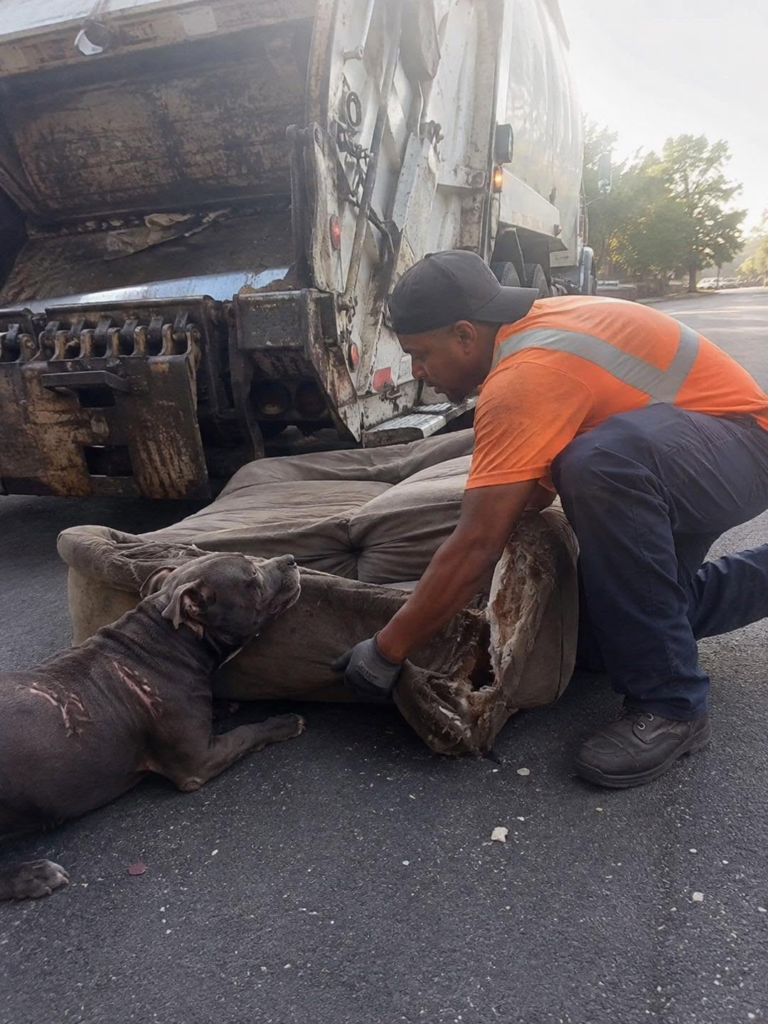
The Scarred Pit Bull appeared just as the garbage truck was preparing to lift the sofa, and for thirty-seven-year-old sanitation worker Calvin Harper, who had spent more than a decade driving collection routes through Memphis, Tennessee, the dog’s behavior was strange enough to make him forget about the clock, the rain, and the long line of houses waiting for their trash to be collected. Calvin had seen almost everything during his years on the job: abandoned mattresses soaked by thunderstorms, refrigerators left beside curbs, broken televisions, furniture filled with insects, and once even a perfectly good piano that someone had simply decided they didn’t want anymore. He had also seen frightened dogs run from the noise of a garbage truck and curious strays follow behind it looking for scraps. But he had never seen a dog deliberately put itself between an eighteen-thousand-pound truck and a piece of discarded furniture.
It was just after six in the morning on a gray Tuesday in the Orange Mound neighborhood. Rain had been falling since before sunrise, not hard enough to create puddles but steadily enough to soak Calvin’s reflective jacket and make every road surface shine beneath the streetlights. His partner, Leonard Price, stood beside the hydraulic controls while Calvin kept the truck positioned near the curb. The sofa looked as though it had been abandoned for months even though it had probably been placed outside only the previous evening. Its brown floral fabric was torn along one arm, the cushions were stained, and one wooden leg had broken halfway through. A red bulky-item collection sticker was still attached to the back. There was nothing about it that suggested it mattered to anyone anymore.
Then the dog appeared.
He came from behind a rusted chain-link fence, moving slowly at first. He was a large brindle Pit Bull with a broad white chest, a faded green collar, one ear bent permanently forward, and a pale scar running across the bridge of his nose. Another scar circled his neck beneath the collar, suggesting that someone had once kept him restrained too tightly. Mud covered his legs, his ribs were visible beneath his short coat, and his eyes looked tired. Yet the moment he saw the sofa, his entire posture changed.
Leonard noticed him first.
=
“Calvin, we’ve got company.”
Calvin glanced toward the mirror and saw the dog walking directly toward the furniture. He expected it to sniff around for food, but instead the Pit Bull stopped beside the sofa and stared at the hydraulic arm. Leonard secured the straps underneath the frame. The dog watched every movement. When the sofa began rising from the pavement, the Pit Bull suddenly jumped forward and pushed against it with both front paws. Leonard immediately released the controls.
“Whoa, buddy.”
The dog dropped back to the ground, circled the sofa, and began sniffing underneath it.
Calvin lowered his window.
“Leonard, don’t lift it again yet.”
Leonard looked over his shoulder.
“You think he’s going to bite?”
“I don’t know.”
The dog looked toward the truck.
Then toward Calvin.
Then back at the sofa.
Calvin had spent enough time around animals to recognize fear, aggression, and curiosity, and this wasn’t any of those things. The dog seemed desperate. His nose repeatedly searched along the lower seam of the sofa, and every few seconds he glanced toward the truck as if checking whether the workers were about to move it again. Leonard tried to step closer, but the Pit Bull immediately placed himself between the man and the furniture.
“Easy,” Leonard said, backing away.
Calvin climbed down from the cab.
The rain ran from the brim of his cap as he approached.
“Hey, boy. Nobody’s trying to hurt you.”
The dog looked at him.
For a moment, Calvin thought the animal might run.
Instead, it returned to the torn section beneath the sofa’s right armrest. He pushed his muzzle into the opening and made a soft, almost desperate sound.
Calvin crouched.
“What are you hearing?”
Leonard came around the other side.
“Could be a cat.”
The Pit Bull growled.
Not at Calvin.
Not even at Leonard.
At the sofa.
Then came another sound.
Very faint.
Calvin leaned closer.
He heard something.
A tiny cry.
He looked at Leonard.
“Turn the truck off.”
Leonard shut down the engine.
The sudden silence made the rain seem much louder.
Calvin crouched beside the sofa again.
There it was.
A weak, high-pitched sound.
Then another.
Leonard’s face changed.
“That’s not a raccoon.”
“No.”
Calvin pulled the utility knife from his vest.
The Pit Bull stepped closer but did not interfere.
Calvin carefully cut through the wet fabric.
Inside the torn seam was a layer of newspaper, foam, and insulation. He pulled the material away slowly until he could see a small gray paw.
His heart stopped.
“Leonard…”
The two men opened the sofa wider.
Inside the hollow wooden frame was a thin calico cat curled tightly around six newborn kittens. The mother was barely moving, her ribs visible beneath her damp fur. The kittens were tiny enough to fit into Calvin’s palm, their eyes still sealed and their bodies trembling from the cold.
Leonard whispered.
“How did they get inside?”
Calvin didn’t answer.
He was looking at the dog.
The Pit Bull had lowered himself beside the opening. He wasn’t trying to get at the cats. He was watching them.
Then the mother cat slowly extended one paw.
It touched the dog’s scarred muzzle.
The Pit Bull closed his eyes.
Calvin felt something tighten in his chest.
“Look at that.”
Leonard nodded.
Neither man spoke for several seconds.
Then the dog stood, walked toward a nearby hedge, and disappeared beneath it.
A few moments later, he came back carrying a crushed paper bowl.
Inside were several pieces of wet dog food.
He placed it beside the sofa.
Calvin stared.
The dog’s chin was covered with dried milk.
Suddenly, everything made sense.
The Pit Bull hadn’t just discovered the kittens.
He had been feeding them.
He had probably been sleeping beside the sofa through the rain, protecting them from other animals and scavenging food whenever he could.
And when the garbage truck arrived, he had understood exactly what was about to happen.
Calvin looked at the eighteen-thousand-pound truck.
Then at the dog.
Then at the six helpless kittens.
The animal had placed himself beneath the tire because he had no other way to stop them from being taken away.
Calvin slowly reached toward the Pit Bull.
The dog allowed him to touch his head.
“Good boy,” Calvin whispered.
But the rescue was only beginning.
Because when Calvin examined the dog’s faded green collar, he found something that would lead to another mystery—one involving a missing owner, an old photograph, and a dog who had been wandering Memphis streets for far longer than anyone realized.

PART 2 — THE COLLAR
Animal control arrived less than half an hour later. The officer, Rachel Monroe, carefully examined the sofa before helping Calvin remove the mother cat and kittens. The mother was dangerously weak, and the kittens were cold, but they were alive. Rachel wrapped them in heated blankets while another worker prepared a carrier. Throughout the entire process, the Pit Bull refused to leave. He followed the carrier with his eyes and stood beside the sofa until every kitten was safely moved.
Rachel eventually crouched beside him.
“Where did you come from, handsome?”
The dog looked at her but did not move.
Calvin explained everything he had seen.
“He’s been protecting them.”
Rachel glanced at the crushed bowl.
“Looks like he has.”
Then she noticed the dog’s collar.
The green material was badly faded and worn nearly white around the edges. Rachel ran her fingers underneath it and discovered a tiny metal identification plate hidden beneath the fur.
She wiped away the mud.
A number appeared.
Rachel entered it into her database.
Her expression changed.
“What?”
Calvin stepped closer.
“This dog has a record.”
Rachel turned the screen toward him.
The Pit Bull’s name was Brutus.
He had been reported missing five months earlier.
His owner was listed as Harold Whitaker, a thirty-one-year-old Memphis electrician.
Calvin looked at the dog.
“Five months?”
Rachel nodded.
“His owner reported him missing after a house fire.”
“What happened to the owner?”
Rachel hesitated.
“He died in that fire.”
The words silenced Calvin.
He looked down at Brutus.
The dog was sitting beside the carrier where the kittens were being treated.
Rachel continued.
“According to the report, Brutus disappeared a few days after Harold’s funeral. The family searched for him, but they eventually assumed someone had taken him.”
Calvin remembered the scars.
“Maybe someone did.”
Rachel shook her head.
“Could be.”
Calvin crouched beside Brutus.
The dog looked toward the road.
He seemed restless.
Almost as though he wanted to leave.
Calvin followed his gaze.
Nothing was there.
Then Brutus suddenly moved toward a pile of garbage bags beside the original sofa.
He sniffed one.
Ignored it.
Sniffed another.
Then began scratching at the third.
Calvin looked at Rachel.
“What is he doing?”
“I don’t know.”
They opened the bag.
Inside were old clothes, cardboard, cans, and a torn blue blanket.
Calvin lifted the blanket.
Something fell from it.
A photograph.
It showed Harold standing beside Brutus when the dog was younger and healthier. Harold was smiling with one arm around the dog’s neck.
Calvin turned the photograph over.
There was handwriting on the back.
If you ever get lost, remember where home is.
Calvin read it twice.
Rachel stared at the photograph.
“This dog has been trying to go home.”
Calvin looked at Brutus.
“Maybe he has.”
But then Rachel noticed something else.
A faded address label was sewn into the corner of the blue blanket.
It belonged to a property only a few streets away.
Harold’s former home.
Rachel frowned.
“That house burned down.”
Calvin looked at Brutus.
The Pit Bull was already walking toward the street.
He stopped.
Looked back.
Then walked again.
It was as if he expected them to follow.
Calvin sighed.
“Let’s see where he wants to take us.”
They followed the dog.
The house stood behind an overgrown yard with broken windows and blackened walls. The fire had destroyed much of the interior, but one side entrance remained intact.
Brutus went directly toward it.
Rachel found the door unlocked.
Inside, the air smelled of wet wood and ash.
Brutus moved through the hallway without hesitation.
He stopped outside a small bedroom.
Calvin looked around.
“Did Harold keep him here?”
Rachel nodded.
“Probably.”
Brutus scratched at a pile of collapsed furniture.
Calvin moved it aside.
Beneath an old blanket was a wooden box.
Rachel opened it.
Inside were veterinary records, dog toys, photographs, and several letters.
One letter had never been opened.
It was addressed to Brutus.
Rachel handed it to Calvin.
He read it aloud quietly.
Harold had written it months before the fire, explaining that he had been planning to move to a safer house and wanted Brutus to have a yard. He wrote about how much he loved the dog and promised that no matter where life took them, Brutus would always have a home.
At the bottom, Harold had written one sentence.
If I ever disappear, don’t let him think I left him.
Calvin looked at Brutus.
The dog was standing beside him.
For five months, he had been alone.
And somehow, during that time, he had found six newborn kittens hidden inside a discarded sofa and decided they needed him.
Calvin understood something then.
Brutus hadn’t stopped the garbage truck because he wanted to save a piece of furniture.
He had stopped it because he had learned what it meant to lose a home.
And he refused to let those kittens lose theirs.
Rachel wiped her eyes.
“What happens to him now?”
Calvin looked at the dog.
“I think someone needs to give him a home.”
But before they could leave, Brutus walked toward a damaged wall.
He sniffed beneath a broken cabinet.
Then he scratched.
Calvin pulled it away.
A small metal box was hidden underneath.
Rachel opened it.
Inside was a set of keys, an old photograph, and a note.
The note contained an address.
Not Harold’s.
A local animal shelter.
The same shelter where Harold had once volunteered.
Rachel stared at the paper.
“He was going there.”
Calvin looked at Brutus.
The dog had been trying to reach the place his owner had once considered his second home.
But nobody knew why.
Until they found the final photograph.
It showed Harold standing inside the shelter with a group of rescued animals.
On the back was another message.
One day, Brutus will understand that home isn’t where you started. It’s where you are needed.
Calvin looked at the dog.
Suddenly, the meaning of the morning became clear.
Brutus had lost his home.
But he had found another purpose.
And six tiny lives were still waiting for him.
PART 3 — THE DOG WHO REFUSED TO WALK AWAY
The kittens survived.
That was the first good news.
The mother cat received treatment for dehydration and malnutrition, while the six kittens were placed in a warm foster environment. Over the following weeks, they gained weight and began opening their eyes. The shelter staff expected the Pit Bull to become less interested once the kittens were safe, but Brutus continued visiting them whenever he could.
Calvin visited too.
He had never expected a single garbage collection route to affect him so deeply. For eleven years, he had treated discarded furniture as part of his daily routine. But after meeting Brutus, he began noticing things differently. He started checking abandoned sofas more carefully before they were loaded. He began looking beneath mattresses and inside broken cabinets. He asked neighbors whether they had seen animals around bulky waste.
He never wanted to hear another cry from inside something headed toward a compactor.
Brutus eventually went to live with Harold’s sister, Marissa Whitaker, who had been searching for him since his disappearance. When she saw him again, she cried so hard that she could barely stand.
Brutus recognized her immediately.
He pressed his head against her chest.
Marissa held him tightly.
“I thought I’d lost you too.”
Brutus wagged his tail.
He was home.
But the story did not end there.
Marissa eventually adopted the mother cat and one of the kittens. The other five were adopted by families across Memphis. Every kitten survived because one injured dog had refused to leave them.
One Saturday afternoon, several months after the rescue, Calvin was invited to the shelter for a small adoption event.
Brutus was lying beneath a tree while children played nearby.
Calvin walked toward him.
The dog lifted his head.
Then he recognized Calvin.
His tail began tapping against the grass.
Calvin sat beside him.
“You remember me?”
Brutus leaned against his leg.
Marissa smiled from nearby.
“He remembers everyone who helped him.”
Calvin scratched the scar across Brutus’s nose.
“You saved them, didn’t you?”
Brutus looked toward the shelter.
Inside, the last kitten from the litter was sleeping in a warm bed.
Calvin smiled.
“You knew they needed you.”
Marissa sat down beside them.
“He lost Harold, his house, and almost everything familiar to him.”
Calvin looked at Brutus.
“And still he protected something smaller than himself.”
Marissa nodded.
“That sounds like Harold.”
For a while, none of them spoke.
The story of Brutus eventually spread through the neighborhood. People began calling him the “Sofa Dog,” though Calvin always corrected them.
“He wasn’t protecting the sofa,” he would say.
“He was protecting a family.”
Months later, Calvin returned to the same sanitation route.
The weather was warm this time.
The curb was clean.
The old sofa was gone.
But Calvin slowed his truck as he passed the spot.
He remembered the rain.
The hydraulic arm.
The scarred dog.
The tiny cries.
And the moment he had realized that the animal beneath his tire wasn’t afraid of death.
He was afraid of losing someone else.
Calvin sometimes wondered what would have happened if he had been in a hurry that morning.
What if he had ignored the dog?
What if he had assumed the Pit Bull was aggressive?
What if he had lifted the sofa anyway?
The thought was enough to make him grip the steering wheel more tightly.
Because the difference between tragedy and rescue had been only a few seconds.
And one dog refusing to move.
Brutus had no way to explain what was happening.
He couldn’t speak.
He couldn’t point.
He couldn’t call the police.
He could only run to the sofa, return to the truck, and finally place his own body in front of the tire.
So that’s what he did.
He trusted someone would understand.
And eventually, someone did.
Years later, Calvin still told the story whenever a new sanitation worker asked him why he checked abandoned furniture so carefully.
He always told them about Brutus.
He told them about the scars on his face.
He told them about the faded green collar.
He told them about the six kittens hidden inside a broken sofa.
And he told them about the morning when an eighteen-thousand-pound truck stopped because a stray-looking Pit Bull decided that six tiny lives were worth risking everything for.
But the part Calvin remembered most wasn’t the rescue.
It was what happened afterward.
Brutus had lost the man who raised him.
He had spent months alone.
He had every reason to become frightened, angry, or indifferent.
Instead, he found something helpless and decided to protect it.
That was what changed Calvin.
Because sometimes life doesn’t give people—or animals—the ending they deserve.
Sometimes homes burn down.
People disappear.
Families are broken apart.
And sometimes all you have left is a scar, an old collar, and a memory of what home used to feel like.
But Brutus proved that losing your home doesn’t mean you’ve lost your ability to love.
On that rainy Memphis morning, a sanitation worker thought he was collecting an abandoned sofa.
Instead, he discovered six lives hidden inside it, reunited a lost dog with the memory of his owner, and learned a lesson he would carry for the rest of his life.
The dog everyone might have called dangerous had actually been the one protecting the helpless.
The animal everyone might have ignored had been the one who noticed the cries.
And the scarred Pit Bull who had spent months wandering the streets had finally found his way home—not because someone rescued him first, but because he had spent those lonely months rescuing someone else.
