
Everyone at the Shelter Called the 90-Pound Scarred Pit Bull “The Most Dangerous Dog in Kennel 17” and Warned Visitors Never to Enter Without Staff, But One Quiet Man Ignored Every Warning, Sat Down on the Concrete Floor With Nothing but an Old Blanket and a Paperback Book, and What the Terrified Dog Did Hours Later Left the Entire Shelter in Tears…

PART 1 — THE DOG BEHIND THE WARNING SIGN
Nobody at the Red Creek County Animal Shelter wanted to talk about Kennel 24 after sunset. During the day, the building was filled with the ordinary chaos of rescue work—dogs barking whenever someone passed, volunteers carrying bowls of food, families looking for puppies, phones ringing at the front desk, and staff members rushing from one emergency to another. But Kennel 24 was different. The noise seemed to disappear around it. People approaching that section instinctively lowered their voices, and visitors who had been smiling moments earlier often stopped when they saw the large red warning sign attached to the metal gate: DO NOT ENTER WITHOUT STAFF — BEHAVIORAL RESTRICTIONS APPLY. Behind that gate sat a ninety-pound white Pit Bull named Brutus, a massive dog with a broad chest, cloudy gray eyes, an old tear through one ear, and several scars stretching across his neck and shoulders. He looked powerful enough to frighten anyone who didn’t know him, but the strange part was that Brutus almost never acted aggressive. He didn’t bark at strangers. He didn’t slam himself against the gate. He didn’t bare his teeth. Instead, he sat in the farthest corner of the kennel with his body pressed tightly against the wall, watching every person who walked past as if he were waiting for something terrible to happen.
The shelter’s records described him as “high risk,” “fear reactive,” and “difficult to handle.” He had been transferred between facilities twice, returned by a foster family once, and placed under strict handling restrictions after panicking during a routine examination. The file contained photographs of his injuries from the day he had been rescued, but no complete explanation of how they had happened. What the records did show was a pattern. Brutus became terrified whenever a metal object hit the floor. He shook when someone shouted. He sometimes urinated when an unfamiliar man approached too quickly. If someone lifted a hand suddenly, he dropped flat against the concrete and covered his head. Yet because he was enormous, muscular, and covered in scars, most people interpreted those reactions as signs that he was preparing to attack. Visitors would stop in front of his kennel, look at his size, read the warning sign, and immediately move away. Nobody wanted to risk being the person who discovered what the dog was capable of doing.
For nearly eight months, Brutus remained in that kennel. Eight months of watching other dogs leave while he stayed behind. Puppies were adopted within days. Older dogs found foster families. Even animals with behavioral problems eventually found someone willing to take a chance on them. Brutus didn’t. Every time a potential adopter asked about him, the staff had to explain the restrictions. They had to explain that he couldn’t be approached suddenly, that he needed controlled introductions, that he might require long-term behavioral support, and that nobody knew exactly what had happened during the first years of his life. Most people listened politely, thanked them, and chose another dog. Eventually, even some of the volunteers stopped asking about him.
The shelter director, Nora Whitmore, hated admitting it, but she had begun to fear that Brutus might never leave. The county had scheduled another behavioral review, and everyone understood what that could mean. If the review determined that Brutus remained too unpredictable for adoption, the shelter might have to make an impossible decision. Nora had spent seventeen years rescuing animals, and she had learned that the hardest cases weren’t always the animals that wanted to hurt people. Sometimes the hardest cases were animals so frightened that they could no longer believe people were safe. Brutus seemed to belong to that second category. The problem was that nobody had figured out how to convince him.
Then, on a rainy Thursday afternoon, a stranger walked into the shelter carrying an old paperback novel.
=
His name was Daniel Mercer.
He was forty-six years old, lived alone outside Flagstaff, Arizona, and worked as a building inspector. He wasn’t a professional dog trainer. He didn’t have a history of rehabilitating aggressive animals. He didn’t even come to the shelter intending to adopt a dog. He had arrived because a friend had told him about a rescue dog that needed someone patient enough to spend time with him. Daniel had almost turned around when Nora told him which dog she meant.
“You should understand something before you meet him,” Nora said.
Daniel looked toward the kennel wing.
“What kind of something?”
“He’s scared.”
Daniel nodded.
“Most dogs in here are.”
Nora shook her head.
“Not like him.”
She led Daniel toward Kennel 24 and stopped several feet away. Brutus immediately noticed the unfamiliar man. His head lifted. His ears flattened. His body became rigid, and within seconds he had backed himself into the corner. Daniel didn’t move closer.
Nora lowered her voice.
“Don’t stare at him. Don’t reach toward him. If he retreats, let him. If he becomes agitated, I want you outside immediately.”
Daniel watched the dog quietly.
Then he asked, “How long has he been afraid?”
Nora looked at him.
“We don’t know.”
Daniel nodded slowly.
“I think he knows.”
Nora frowned.
“What do you mean?”
Daniel looked at Brutus again.
“He knows why.”
The answer stayed with Nora long after Daniel walked away from the kennel. Ten minutes later, he returned carrying a folded blanket.
“What’s that for?” Nora asked.
“May I sit with him?”
Nora hesitated.
“You can’t touch him.”
“I don’t intend to.”
“You can’t try to make him come to you.”
“I won’t.”
“You can’t feed him.”
Daniel shook his head.
“I won’t.”
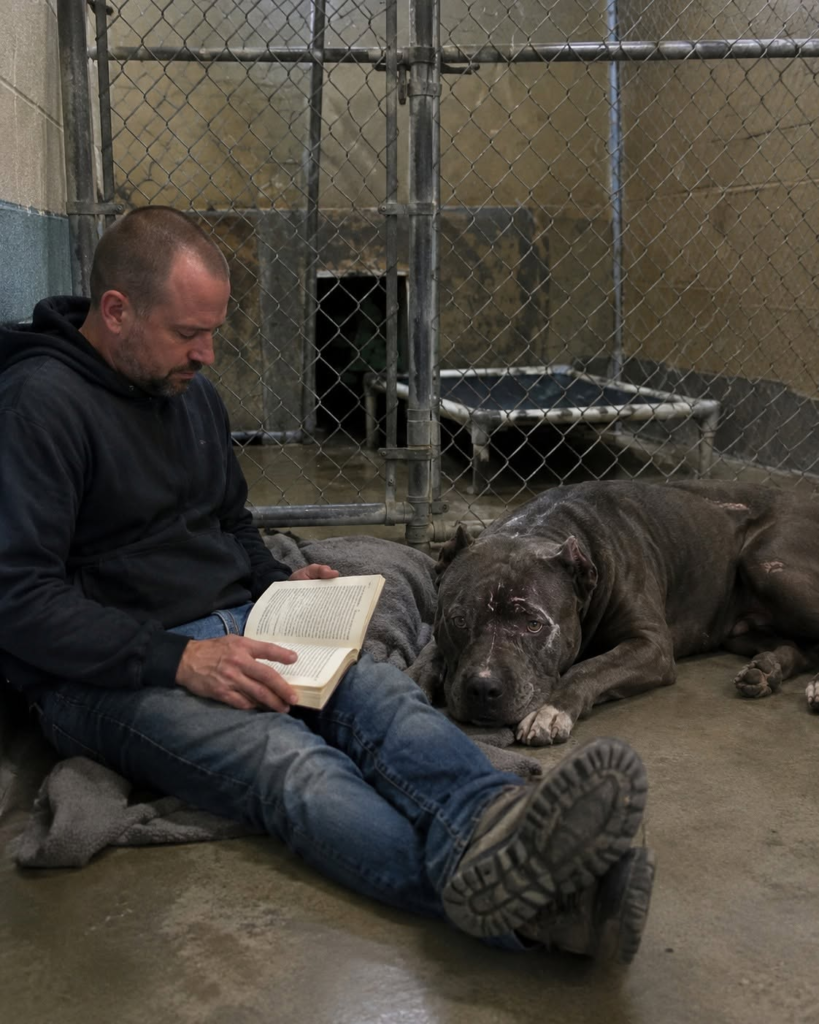
Nora studied him for a moment before finally unlocking the kennel. Daniel stepped inside, placed the blanket on the concrete several feet away from Brutus, sat down, and opened his paperback novel.
He began reading.
That was all.
Brutus stared at him.
Daniel didn’t look up.
Five minutes passed.
Then fifteen.
Then thirty.
Nothing happened.
A few employees gathered outside the kennel window, whispering among themselves. They expected Daniel to become frustrated or bored. Instead, he turned another page. Every so often he adjusted his position, but otherwise he remained completely still. Brutus continued watching him from the corner, his eyes tracking every movement.
An hour passed.
Daniel kept reading.
Nora finally opened the door slightly.
“You don’t have to stay all night.”
Daniel looked up.
“Has anyone ever stayed?”
Nora didn’t answer.
Daniel looked toward Brutus.
“Then maybe that’s what he needs.”
The door closed again.
Another hour passed.
The shelter became quiet. The last visitors left. The lights in the adoption area were switched off. One by one, the volunteers went home. But Daniel remained on the floor of Kennel 24, reading a battered paperback under the fluorescent lights.
At 11:52 p.m., something changed.
Brutus stood.
Nora, watching the security monitor from her office, leaned toward the screen.
The dog took one cautious step.
Then another.
His legs were trembling.
Daniel didn’t look at him.
Brutus stopped.
A few seconds passed.
He moved again.
He was now several feet from the corner.
Then a metal cart crashed somewhere in the back hallway.
Brutus panicked.
He spun around and slammed into the wall, his entire body shaking. His breathing became rapid. He pressed himself into the corner as if trying to disappear.
Nora expected Daniel to stand.
He didn’t.
She expected him to speak.
He didn’t.
Daniel simply turned another page.
Brutus stared at him.
The dog seemed confused.
Fear had always changed humans before.
Fear made them angry.
Fear made them shout.
Fear made them grab him.
Fear made them punish him.
But this man did nothing.
He remained exactly where he was.
Quiet.
Predictable.
Still.
And slowly, Brutus stopped watching the door.
He began watching Daniel.

PART 2 — THE FIRST TIME HE CHOSE SOMEONE
At 1:06 a.m., Nora was still sitting in front of the security monitor. She had called her assistant, Jenna Morales, back to the shelter because neither of them could believe what they were watching. Brutus had left the corner again. The ninety-pound dog was standing several feet behind Daniel, who was still sitting on the blanket with the paperback open in his hands. The dog wasn’t confident. His head remained low, his muscles tense, and his breathing uneven. But he was moving forward by choice. No leash was attached to him. No treat was being held out. Nobody was calling his name. Nobody was telling him what to do.
Brutus took one step.
Then another.
Daniel turned a page.
The dog stopped behind him.
For almost ten minutes, nothing happened.
Then Brutus slowly lowered his head.
His nose came within inches of Daniel’s shoulder.
Daniel remained still.
Brutus took another breath.
Then he lowered his enormous head until his chin rested gently against Daniel’s boot.
Nora covered her mouth.
Jenna started crying.
Neither woman said anything.
Because they both understood what they were witnessing.
This wasn’t obedience.
It wasn’t training.
It wasn’t a command.
Brutus had chosen contact.
After months of refusing human touch, the dog had voluntarily crossed the kennel and placed himself against someone.
Daniel slowly closed his book.
He looked down.
His eyes filled with tears.
For several seconds, he didn’t move.
Then he whispered, “You’re okay, buddy.”
Brutus didn’t move.
Daniel placed his hand on the blanket instead of touching him.
The dog stared at the hand.
Then, slowly, he moved his chin from Daniel’s boot and placed it against Daniel’s palm.
Daniel’s shoulders shook.
He was crying.
Not loudly.
Not dramatically.
Just silently.
Because he understood what that tiny movement meant.
Brutus wasn’t trusting him completely.
He was offering the smallest piece of trust he had.
And Daniel knew better than to ask for more.
The next morning, the shelter staff expected Brutus to return to his corner. Instead, they found him sleeping on the blanket.
When Daniel arrived, Brutus stood immediately.
He walked toward the gate.
He didn’t bark.
He didn’t retreat.
He simply waited.
Nora unlocked the kennel.
Daniel sat down.
Brutus approached.
This time, he didn’t need an hour.
He walked directly to Daniel and lay beside him.
That moment changed the entire direction of Brutus’s case.
Over the next several weeks, Daniel returned every day. Sometimes he sat for twenty minutes. Sometimes he stayed for hours. He read his books. He listened to music quietly through headphones. He occasionally talked to Brutus, but never demanded a response. If the dog walked away, Daniel let him. If Brutus became frightened, Daniel gave him space. If he approached, Daniel allowed him to decide how close he wanted to be.
The first time Daniel touched Brutus’s neck, it lasted less than three seconds.
Brutus immediately stepped away.
Daniel smiled.
“That’s enough.”
The next day, Brutus allowed five seconds.
Then ten.
Then thirty.
Eventually, the dog began resting his head in Daniel’s lap.
The transformation wasn’t dramatic.
It happened so slowly that people almost missed it.
Brutus stopped hiding when volunteers entered the room.
He started accepting treats from Nora.
He began walking on a leash.
He learned that a dropped bowl didn’t mean someone was going to hurt him.
He learned that raised voices didn’t always lead to punishment.
Most importantly, he learned that Daniel always came back.
That became the foundation of everything.
Daniel could leave.
Brutus would survive.
Because Daniel returned.
Again.
And again.
And again.
Around this time, Nora reopened Brutus’s old records. She contacted the previous shelters and asked for every available document. The information that came back was disturbing. One shelter had documented old injuries that had never been properly explained. Another had reported that Brutus became terrified around certain men. A third had found him severely underweight after he had apparently been confined for an extended period in a small outdoor enclosure.
The pieces began fitting together.
Brutus wasn’t a dangerous dog who had learned fear.
He was a frightened dog who had been mistaken for dangerous.
The distinction changed everything.
The shelter began working differently with him. Instead of forcing him into situations that frightened him, staff gave him choices. Instead of punishing retreat, they allowed retreat. Instead of demanding obedience before trust, they built trust first.
Brutus began responding.
Six months after Daniel first entered Kennel 24, the dog who had once been considered nearly impossible to handle walked calmly through the shelter lobby.
A little girl sitting near the reception desk stared at him.
“Is he the scary dog?”
Daniel smiled.
He looked down at Brutus.
“No.”
The girl looked confused.
Daniel gently scratched the dog’s neck.
“He’s just a dog who had some very bad people in his life.”
Brutus leaned against Daniel’s leg.
The little girl smiled.
“Can I pet him?”
Daniel looked at Brutus.
The dog remained calm.
Daniel nodded.
“Let him come to you.”
The girl held out her hand.
Brutus approached slowly.
He sniffed her fingers.
Then he sat.
The girl gently touched his shoulder.
Brutus didn’t move.
Nora watched from behind the desk with tears in her eyes.
Eight months earlier, she had been afraid the dog might never leave Kennel 24.
Now a child was petting him in the middle of the shelter lobby.
PART 3 — THE DOG WHO FINALLY CAME HOME
Daniel had never planned to adopt Brutus. At least, that was what he told himself during the first month. He said he was only helping the shelter. Then he said he was only helping Brutus. Later he stopped making excuses altogether.
The truth was obvious.
Brutus had chosen him.
And Daniel had chosen Brutus.
The adoption paperwork was finalized on a cold Saturday morning. There was no dramatic ceremony. No television cameras. No crowd waiting outside. Just Nora, Jenna, Daniel, and a ninety-pound white Pit Bull standing beside the shelter door.
Brutus stopped when he saw the parking lot.
He looked back.
For a moment, Nora wondered if he was remembering everything that had happened there.
The fear.
The loneliness.
The endless days behind the gate.
Then Daniel crouched beside him.
“You ready?”
Brutus looked at him.
Daniel waited.
After several seconds, Brutus stepped forward.
He climbed into Daniel’s truck.
Nora wiped her eyes.
She knew this wasn’t another transfer.
This time, Brutus was going home.
The first few weeks were difficult. The washing machine terrified him. The vacuum cleaner sent him running. A dropped pan caused him to hide beneath the kitchen table. Sometimes Daniel would find him standing in the hallway at two in the morning, staring at a closed door.
Daniel never became frustrated.
He sat on the floor.
He waited.
Eventually, Brutus would approach.
Sometimes it took ten minutes.
Sometimes an hour.
Daniel didn’t care.
He had learned something important from that first night in Kennel 24.
Progress couldn’t be forced.
Trust couldn’t be demanded.
Healing couldn’t be rushed.
So he stayed.
One evening, months after the adoption, Daniel was lying on his living room floor reading the same kind of paperback novel he had carried into the shelter that first night. Brutus was lying beside him.
The massive dog had one paw resting across Daniel’s chest.
His eyes were closed.
His body was completely relaxed.
Daniel looked down at him and smiled.
He took a photograph.
The picture eventually spread online.
The caption beneath it was simple:
“Sometimes the dogs everyone fears most are carrying the deepest fear themselves.”
Thousands of people shared it.
Then millions saw it.
Messages arrived from rescue workers, veterinarians, adopters, and people who had once been afraid of large dogs. Many wrote about animals who had been misunderstood because of their size, breed, scars, or behavior.
But Daniel never allowed the photograph to become a story about him.
Whenever someone asked what he had done to change Brutus, his answer remained the same.
“Nothing.”
People would laugh.
Daniel would shake his head.
“I didn’t fix him. I just stopped making him afraid of me.”
That sentence eventually became something the shelter staff repeated when new volunteers arrived.
Nora even changed the shelter’s training program.
Dogs showing fear-based behavior were no longer automatically described as aggressive without deeper assessment. Volunteers were taught to recognize shutdown, trembling, avoidance, and panic. Quiet rooms were created for animals that needed less stimulation. Staff members were encouraged to spend time near frightened dogs without touching them.
Kennel 24 eventually became empty.
But nobody wanted to use it immediately.
Nora left the old warning sign on the wall for several months.
Not because she still considered Brutus dangerous.
Because she wanted everyone who worked there to remember how easily fear could be misunderstood.
Eventually, she replaced the warning sign with a small plaque.
It read:
“Before you decide what an animal is, ask what happened to him.”
Years passed.
Brutus never became the kind of dog who loved every stranger.
He didn’t need to.
He still preferred quiet rooms.
He still avoided sudden movements.
He still became nervous around loud arguments.
But he had a home.
He had a person.
He had a couch.
He had a backyard.
And every evening, when Daniel sat down to read, Brutus would walk over and lie beside him.
Sometimes the dog rested his head against Daniel’s leg.
Sometimes he placed one enormous paw across Daniel’s foot.
And sometimes he simply slept.
That was enough.
Because the dog who had once spent months staring at the shelter wall now spent his nights sleeping peacefully beside someone who had never once demanded that he become fearless.
Daniel understood that Brutus might always carry pieces of his past.
But he also understood something else.
A scar doesn’t always mean a wound is still open.
Fear doesn’t always mean danger is coming.
And a dog that looks dangerous from the outside may simply be waiting for someone patient enough to discover what is underneath.
Years later, when Nora told the story of Kennel 24 to new volunteers, she always described the same moment.
A ninety-pound Pit Bull.
A frightened dog.
A cold concrete floor.
An old blanket.
A battered paperback book.
And a quiet man who refused to ask for anything.
Then she would pause.
She would tell them how Brutus had slowly crossed the kennel.
How he had stopped behind Daniel.
How he had lowered his head.
And how he had rested his chin against the man’s boot.
Most people imagined that the important moment came when Daniel adopted him.
It didn’t.
It happened much earlier.
It happened when Brutus discovered that a human being could sit beside him without demanding anything.
That was when the dog began to understand that maybe the world had changed.
Maybe every hand wasn’t going to hurt him.
Maybe every voice wasn’t going to become a shout.
Maybe every stranger wasn’t a threat.
Maybe someone could leave and still come back.
And maybe, after years of surviving, he was finally allowed to live.
The shelter had called him dangerous.
His file had called him unpredictable.
Visitors had called him frightening.
But Daniel had seen something completely different.
He had seen a dog who was scared.
A dog who was exhausted.
A dog who had spent too long waiting for the next bad thing to happen.
And sometimes, the greatest rescue doesn’t happen when someone opens a kennel door.
Sometimes it happens when someone sits down beside the animal inside and quietly proves that the danger is over.
For Brutus, that proof began with an old blanket.
A paperback book.
And one stranger willing to stay.
Everything else came after.
